Showing posts with label volunteerism. Show all posts

Wednesday, March 05, 2008

Whatever Happened to Puppy?

Jeff Koons
Puppy, December 1995 - March 1996
Museum of Contemporary Art, Sydney
Kaldor Art Projects

The Artswipe was feeling kinda nostalgic this week. So much so I started thinking about Jeff Koons. (When I'm nostalgic I always think about artists who made a splash in the 80s and early-mid-90s. Don't we all?) Amidst the flood of fond memories, I recalled the time I helped out on the installation for Jeff Koons's Puppy when it was being planted outside the Museum of Contemporary Art in the early-mid-90s. (A quick Google search revealed it was 1995/1996 - geez sorry for the lack of specificity - if it wasn't for the web I would not remember for sniffing so much weedkiller in my day... Plus I forgot to add that week of gardening to my Art CV).

Overcome by the return of a repressed memory, I took a trip down to Circular Quay today just to reminisce. I started thinking about the old days - the gentler times - when volunteerism was in my blood and I would help out on
all the big installs - Biennales, Triennials, Perspectas, Puppies - just so I could one day land a job as a museum guide or cloak room clerk. Trekking down to the Quay this afternoon, I made my way past the waterside theatre sports and began walking to the MCA just so I could lie down on the grass and think of Puppy and how much s/he meant to me. Puppy may not be there anymore in reality, but s/he lingers on like a cultural phantom limb, just aching to be scratched. Easily distracted, I had an instant craving for a cheeseburger-hold-the-gherkins. As I crossed the road in a beeline to McDonalds I walked past Customs House and my heart stopped...

There before me was a little floral roadside tribute to Puppy.

The Artswipe
Puppy (In progress), 2008
Public Access Art

Saturday, September 02, 2006

Docile Biennales


Resistance is futile. I have spent the last few weeks battling the art demons in my head that taunt, "Write something about the 2006 Biennale of Sydney, Zones of Contact?" I'd reply: "And just how does one stretch the phrase 'I was bored shitless' over several paragraphs when I could instead renew my World Movies subscription – setting the VCR during anthropological documentary hour."

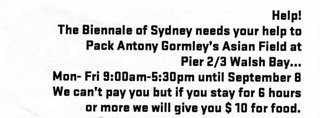
Eventually the demon forced some Artswipe commentary when I encountered a tiny cost-efficient flyer the other day at a Sydney artist run space. The small piece of paper was appealing for volunteers to dismantle Antony Gormley's massive installation, Asian Field, held at Pier 2/3 Walsh Bay. Comprised of approximately 180,000 life-like sculptures, the work is, to quote Gormley, "made by 500 assistants out of 125 tonnes of gritty brick clay in one balmy January week in Xianxian Village, Guangzhou in 2003." Photographs of the villagers who assisted appear in the gallery alongside their pick of the sculptures produced.

In her essay "Grasping the Thistle," which appeared in Zones of Contact: 2006 Biennale of Sydney: Critical Reader published by Artspace, Lisa Kelly succinctly noted how Sydney artists had an opportunity to be part of the event by volunteering for a Biennale where representation from artists in its host city was scarce. Kelly writes:

"Two days prior to the media preview of the exhibition venues, frantic calls for volunteers to assist – particularly with the installation of Antony Gormley’s work Asian Field – were put out to local artists. The pay off for this labour was touted as a chance to work with the artist and a ticket to the exclusive artists' party on opening night. Events this time around would suggest that the Biennale of Sydney holds the Sydney artist community first and foremost as a source of readily exploitable, behind-the-scenes labour."

Perhaps photos of the volunteers setting up the installation should have also been hung somewhere, to rightfully acknowledge Asian Field's multi-faceted dependence on mass-labour? When I viewed Asian Field, I set off an alarm that signified I was too close to the front line of clay creatures comprising the field. Immediately I was apologetic to the gallery assistant, but quickly realised he didn't care because I was part of another mass field of Biennale viewers who had set off that alarm. The sound of tourettic alarms screaming "back off motherfucker" tolled alarm bells of a more critical nature that forced me to read the work as a hermetically sealed environment of cultural otherness. I stood staring out on a world frozen in time and objectified by the time-honoured relationship of handmade artisan labour to an exotic cultural authenticity, however manufactured and trite. Anthony Bond notes in the Biennale catalogue that Asian Field is the first time in the 15 years since embarking on the Field installations that Gormley has pinned up photos of the individual producers. Anonymous mass labour no more – the Marxists in the Village would surely approve!

Having recovered from the embarrassing alarm setting-off experience and exercising my "Sunday best" in panoptic self-regulation, I took the obligatory snaps on my mobile phone camera as all the other viewers were doing. It was then I saw myself reflected in the clay docile bodies staring back at me. Mass responses to the work were mirroring the mass stillness of the field. If the Marxists in the Village can't be pleased, then the Foucauldian scholars among them would be furiously taking notes.

Asian Field certainly works on an aesthetic level, impressing with its monumental and somewhat inherent sense of golden wonder. You can't help but look upon this field as a landscape seen from space because the viewer is imbued with a spectatorial mastery not unlike the kind of experience you'd have if it was downloaded via Google Earth. As spectators we zone in and own the landscape; fields all over the world are brought into sharp focus, their exotic populations reduced to tiny specks of fetishised nothingness. When I saw the Asian Field one viewer said to the guard keeping gallery assistant "What does Communist China think about this work?" The reply was, "You'd have to ask them." Was Asian Field an exercise in commie critique perhaps?

Whatever it aims to do on the part of the artist, Asian Field is racist in the way it reduces Asianness to a generic signifier – much like the way "Asian" food is packaged in Western countries, when in fact you might be experiencing more specific styles of, for example, Chinese or Vietnamese cuisine. It's like Gormley sees all "Asians" as the same and undifferentiated, despite his attempt to showcase the Villager's portraits. Somehow the whole exercise smacks of a sweat shop mentality, and we all know that sweat shops have been particularly criticised for exploiting migrants from Asian countries.

So now citizens in the Sydney art community are being called upon to take down the Asian Field. What do you get in exchange? The flyer says: "We can't pay you but if you stay for 6 hours or more we will give you $10 for food." I couldn't help but wonder if it's $10 worth of food stamps, depression-era style. The thought of a poorly paid Biennale staff member standing there doling out $10 lots of petty cash to wide-eyed volunteers made for a rather surreal image. But no more surreal than the thought of actually wondering where you could dine on $10 in the Walsh Bay / Circular Quay area except perhaps McDonalds. It seems those behind art world institutions like the Biennale of Sydney probably believe in that cruel clichéd joke that artists next to migrants make up a majority of the staff who work at McDonalds. And really artists may as well line up to get jobs at McDonalds if they're expected to support the volunteerism attending large-scale events like the Biennale.