Showing posts with label McDonalds. Show all posts

Sunday, July 01, 2007

McCritical

The Artswipe
Two all-beef patties, special sauce, lettuce, cheese,
pickles, onions on a sesame seed bun, 2007
Found image collage

It was appropriate that Britain should have been represented by that undisputed queen of narcissism, Tracey Emin. She responded in typical fashion, demanding that she only be accommodated at a hotel that had a certain “thread count” in the sheets. She wanted a room for her secretary and a private boat. In return, she produced a series of small, laughably bad drawings; scrappy shapeless paintings; piles of sticks that passed for sculpture; and outline doodles in neon. The theme needless to say was Me, Me, Me.

Her fans were rapt in admiration. “Tracey”, as she is known by all the world, was on hand to do a lot of swearing. For some, this served as confirmation of her genius. If further proof of sainthood was needed, one of the catalogue essays was written by a clergyman who gave a religious spin to Tracey’s art and expletives. For those like me who were not so anxious to worship at her alter, it seemed clear that in terms of her fame and her talent, Tracey is nothing less than the Paris Hilton of contemporary art.
(John McDonald, “Festival of False Gods”, Sydney Morning Herald, June 16-17, 2007).

If Tracey Emin is the Paris Hilton of contemporary art, John McDonald is the Dan Brown of the art critic world. Let me explain.

A week before old McDonald bagged Emin, that bourgeois Herald supplement Good Weekend ran a cover story profiling artists in their studios. Basically a puff-piece to promote John McDonald’s new book, Studio: Australian Painters on the Nature of Creativity, the cover featured Aida Tomescu. I could review this article here at Artswipe in case you missed it, but Good Weekend reader Melanie Flynn of Hawthorn East, Victoria, sums it up perfectly in her letter to the magazine's editor, published this weekend:

The promise of an article about Australia’s top artists (June 9) was sadly short-lived as the author bought into the career story of art critic John McDonald. Surely most people who work within the industry have heard this story time and again and, for those who haven’t,it is hardly gripping stuff. If you are going to descend into the banality of art-world politics, please don’t promise something more by placing a full-page image of a female artist on your cover, who you then hardly mention in the accompanying article. (Good Weekend, 30 June, 2007).

I agree. It’s hardly gripping and it didn't really make me want to rush out and buy the book. McDonald would tear shreds off any other critic who’d dare to produce such nebulous, glossy coffee table criticism. Granted, a book on artists in their studios is an interesting idea; it appeals to our voyeuristic tendencies to know every bit of minutia about celebrity. And indeed, there is a whiff of celebrity about this book in that it appeals to the kind of personality-driven excess that McDonald gets all huffy over - evidenced by his jibe at Tracey Emin. More info on the book is available here and you can even download a nine page PDF sample of the book here.

Studio is available now and for a mere $80 you can furnish your coffee table with a copy. “That’s too much money,” I hear you cry in dismay. Think about it this way: Big Macs cost $3.25 each. With $80 you could either buy John McDonald’s book or visit your local McDonalds and order 24 Big Macs.

Saturday, September 02, 2006

Docile Biennales


Resistance is futile. I have spent the last few weeks battling the art demons in my head that taunt, "Write something about the 2006 Biennale of Sydney, Zones of Contact?" I'd reply: "And just how does one stretch the phrase 'I was bored shitless' over several paragraphs when I could instead renew my World Movies subscription – setting the VCR during anthropological documentary hour."

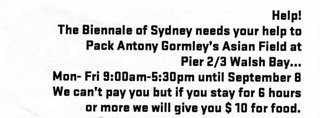
Eventually the demon forced some Artswipe commentary when I encountered a tiny cost-efficient flyer the other day at a Sydney artist run space. The small piece of paper was appealing for volunteers to dismantle Antony Gormley's massive installation, Asian Field, held at Pier 2/3 Walsh Bay. Comprised of approximately 180,000 life-like sculptures, the work is, to quote Gormley, "made by 500 assistants out of 125 tonnes of gritty brick clay in one balmy January week in Xianxian Village, Guangzhou in 2003." Photographs of the villagers who assisted appear in the gallery alongside their pick of the sculptures produced.

In her essay "Grasping the Thistle," which appeared in Zones of Contact: 2006 Biennale of Sydney: Critical Reader published by Artspace, Lisa Kelly succinctly noted how Sydney artists had an opportunity to be part of the event by volunteering for a Biennale where representation from artists in its host city was scarce. Kelly writes:

"Two days prior to the media preview of the exhibition venues, frantic calls for volunteers to assist – particularly with the installation of Antony Gormley’s work Asian Field – were put out to local artists. The pay off for this labour was touted as a chance to work with the artist and a ticket to the exclusive artists' party on opening night. Events this time around would suggest that the Biennale of Sydney holds the Sydney artist community first and foremost as a source of readily exploitable, behind-the-scenes labour."

Perhaps photos of the volunteers setting up the installation should have also been hung somewhere, to rightfully acknowledge Asian Field's multi-faceted dependence on mass-labour? When I viewed Asian Field, I set off an alarm that signified I was too close to the front line of clay creatures comprising the field. Immediately I was apologetic to the gallery assistant, but quickly realised he didn't care because I was part of another mass field of Biennale viewers who had set off that alarm. The sound of tourettic alarms screaming "back off motherfucker" tolled alarm bells of a more critical nature that forced me to read the work as a hermetically sealed environment of cultural otherness. I stood staring out on a world frozen in time and objectified by the time-honoured relationship of handmade artisan labour to an exotic cultural authenticity, however manufactured and trite. Anthony Bond notes in the Biennale catalogue that Asian Field is the first time in the 15 years since embarking on the Field installations that Gormley has pinned up photos of the individual producers. Anonymous mass labour no more – the Marxists in the Village would surely approve!

Having recovered from the embarrassing alarm setting-off experience and exercising my "Sunday best" in panoptic self-regulation, I took the obligatory snaps on my mobile phone camera as all the other viewers were doing. It was then I saw myself reflected in the clay docile bodies staring back at me. Mass responses to the work were mirroring the mass stillness of the field. If the Marxists in the Village can't be pleased, then the Foucauldian scholars among them would be furiously taking notes.

Asian Field certainly works on an aesthetic level, impressing with its monumental and somewhat inherent sense of golden wonder. You can't help but look upon this field as a landscape seen from space because the viewer is imbued with a spectatorial mastery not unlike the kind of experience you'd have if it was downloaded via Google Earth. As spectators we zone in and own the landscape; fields all over the world are brought into sharp focus, their exotic populations reduced to tiny specks of fetishised nothingness. When I saw the Asian Field one viewer said to the guard keeping gallery assistant "What does Communist China think about this work?" The reply was, "You'd have to ask them." Was Asian Field an exercise in commie critique perhaps?

Whatever it aims to do on the part of the artist, Asian Field is racist in the way it reduces Asianness to a generic signifier – much like the way "Asian" food is packaged in Western countries, when in fact you might be experiencing more specific styles of, for example, Chinese or Vietnamese cuisine. It's like Gormley sees all "Asians" as the same and undifferentiated, despite his attempt to showcase the Villager's portraits. Somehow the whole exercise smacks of a sweat shop mentality, and we all know that sweat shops have been particularly criticised for exploiting migrants from Asian countries.

So now citizens in the Sydney art community are being called upon to take down the Asian Field. What do you get in exchange? The flyer says: "We can't pay you but if you stay for 6 hours or more we will give you $10 for food." I couldn't help but wonder if it's $10 worth of food stamps, depression-era style. The thought of a poorly paid Biennale staff member standing there doling out $10 lots of petty cash to wide-eyed volunteers made for a rather surreal image. But no more surreal than the thought of actually wondering where you could dine on $10 in the Walsh Bay / Circular Quay area except perhaps McDonalds. It seems those behind art world institutions like the Biennale of Sydney probably believe in that cruel clichéd joke that artists next to migrants make up a majority of the staff who work at McDonalds. And really artists may as well line up to get jobs at McDonalds if they're expected to support the volunteerism attending large-scale events like the Biennale.

Friday, June 23, 2006

The Vagina Monoblogs


The Artswipe
What is it you kunst face? 2006
Mobile phone photo

I was watching Oprah recently interviewing "age-defying women." It has to be my second favourite Oprah episode (after the one where, as shown above, she works at McDonalds for a day to prove she can be a proletariat if she damn well feels like it). In this episode about "age-defying women" Oprah waxes lyrical with a 50something woman who has kept a youthful visage because she applies vaginal cream on her face daily. This was totally inspired. Basically this vaginal face cream woman is a performance artist and she doesn’t even know it. She may as well be at the forefront of feminist art practice.

By "feminist" I don’t mean bland post-feminist crap (a myth probably invented by Carrie Bradshaw). I am talking about the real stuff: second wave feminism. Where women burnt their bras, worshipped their vaginas, ran with wolves, sculpted with tampons, made the nappy happy and politicised the domestic. They also got real angry at marches and rallies. They loved other women, not always because they were lesbians, but because men are pigs. These second wave womyn would never be seen watching The L Word – or at least they would not admit it. They’d be queuing around the block for tickets to a Barbara Hammer retrospective.

The best thing about the second wave was it allowed you to say “cunt” in a critical context. Specifically because many feminist artists of this era made, what they affectionately called, “cunt art.” Flowers became vaginal signifiers and whirling spiral forms (barbed with the occasional dentata) hypnotised viewers into accepting menopause as a pause from men. To list such pioneers would mean citing the likes of Judy Chicago, Lynda Benglis, Hannah Wilkes, Carolee Schneeman, Vivienne Binns, Barbara Kruger, Jenny Holzer, The Guerrilla Girls, Mary Kelly, among many others. Their more contemporary counterparts are artists like Tracey Emin (before she stopped drinking), Le Tigre (before they covered The Pointer Sisters’ “I'm so Excited”) and Australian dragking foursome The Kingpins (before they terrorised Starbucks
). Why am I going on about this anyway?

Blame Oprah – she makes me think of kunst.