Showing posts with label obituary. Show all posts

Tuesday, February 26, 2008

Death Snub


Phew, just as well the Hollywood writer's strike is over. I was finding it really hard to write for fear of being called a "strikebreaker!" I hate upsetting my peers from the Academy, they're a delicate breed. Celebrating with a quiet flute of bubbly, I watched the Oscars last night and realised that every year I watch mainly because I love the bit where they dim the lights and fire up that good old PowerPoint presentation of dead Hollywood people. If the Oscars are all about your measure of worth in the entertainment industry, then the annual three minute Oscar clip-fest memorialising dead stars is the ultimate test for who we love best. (And if your footage gets slow motion treatment you've really tugged at our heartstrings). In November 2006 Artswipe wrote a tribute for Adrienne Shelley who achieved arthouse cinema fame for acting and directing in her brief lifetime. On Oscar night last year Shelley was not honoured in the death montage. What a crime against cinema.

With this in mind, I was looking forward to the Oscars this year to see how big Heath Ledger's applause would be and whether young actor Brad Renfro (Apt Pupil, Bully, The Client), who died of a heroin overdose a week before Ledger, would get his moment of Oscar hagiography. Much like I anticipated, Renfro was excluded. Since the Oscars were televised the global press has been buzzing with news of Renfro's "Oscar snub". Once you would have expected such a headline to be reserved for that illustrious actor who was cheated out of a much deserved nomination (say Matthew McConaughey for his performance in Fools Gold or Mandy Moore for Because I Said So).

As for Ledger, he was honoured last in the presentation and the applause was deafening. If they had cut back to the audience you would have seen a pre-ad break standing ovation that after a few heartfelt minutes would subside for the bit in the night where an animated character presents an award.

Thursday, January 24, 2008

Young Talent Time

Brace Yourselves

Welcome to 2008! I'm back from the dead... Apologies for the absence but sometimes when Bali comes a calling you have to drop everything, pack your bags and sun yourself in a time and place where climate change comes Batteries Not Included. I'm back now from Summer Break and ready to titillate once again.

The Artswipe plans on a big year of tease, sleaze and disease. Just hold the Quickease - there will be NO illicit drugs on this trip. When will the kids learn to say no to drugs? Speaking of kids and drugs, you can rest assured - rest in peace, so to speak - that The Artswipe shed a little tear this week for Heath Ledger: Perth's own.

When his passing was announced, The Artswipe experienced major media whip-lash. So much so, my neck is in a brace and I'm feeling "very Erin Brockovich". And that dear readers is my metaphor for the global mourning happening right now - we've all got sore necks from the media muteness that has a-come all over us. Those of us not so mute are people like John Travolta. When you have hair-plugs that loud, muteness ain't an option. Travolta's tribute to Ledger has burned in my soul ever since Today Tonight aired it: "He's touched me deeply as a talent and it's a great loss" said Travolta. I know when my loved ones die, I always acknowledge them as "talents" first and foremost. That's what they would have wanted. When The Artswipe's own obituary appears in Art Forum in, I'm guessing the year 2056, the headline will be "TALENT DEAD".

Moral of the story: When they're young, talented and gone well before their time, you can rest assured the world stops-snap-frozen in its Gucci neck brace, glued to a media outpouring more potent and frenzied than any Emerald floodwaters.

Saturday, February 10, 2007

Production Values

The Anna Nicole Show

"As Anna Nicole Smith, the unblushing celebrity whose antics were at once garish and pitiful, collapsed in her suite at a Florida hotel and casino, people sat feeding coins into slot machines five floors below. It was a very American death."
- Ben Cubby & Emily Dunn, "End of a Party Girl," Sydney Morning Herald, 10 February 2007.

These two sentences introduced today's Herald article about the life and death of celebrity train-wreck Anna Nicole Smith, whose life literally derailed the other day when she was found dead in a hotel room. Artswipe has always admired Anna Nicole because she embodied the white trash American dream more than any other. Stitched to the nines in shit for brains cheap glamour, Anna Nicole's circuitous path to fame mirrored the Paris Hilton brand except one was born into hotel money, the other died in a hotel with oil money amassed along the way. Anna Nicole's second husband, a Texan oil tycoon, was a million years her senior when she married him at 26 years of age. He dies, she inherits, and her claim to the cash is contested at Supreme Court. At the time a judge asks Anna Nicole about her situation to which she replies: "I just wanted to make a name for myself." The judge presses her: "What name is that?"

"Anna Nicole Smith," is her winning reply.

Maybe she's a little smarter than the former stripper seemed in the media spectacle groundswell following her every chemically-enhanced hiccup. Born Vicky Hogan in 1967, she changed her name to Anna Nicole at the edge of 17. Around that time Anna Nicole was busy getting married to her first (unwealthy) husband and giving birth to son Daniel, who died suddenly five months ago - a mere three days after Anna Nicole's second child was born. When she changed her name to Anna Nicole, she knew fame was all about the name. Her name. For Anna Nicole, her name was an epic neon wonderbolt lighting up the dank cesspool of famous-for-being-famous celebrity skank. Where Paris Hilton's star emits greenhouse gasses, Anna Nicole's saintly sheen could multitask by eclipsing the planet, sending us into a tailspin of darkly drrrty moments that momentarily plugged the hole in the ozone. Those not content to just look on and admire her gifts to the globe could feed coins into her slot machine. It was a very American life.

One of Anna Nicole Smith's paintings

If she knew her name could attract attention, it was no more honed to perfection than in her reality TV show, The Anna Nicole Show (2002-04). In an episode from the second season, "Something Trendy This Way Comes" (2003) Anna Nicole shows her artist side. This was the side Artswipe loved the most. You see, Anna Nicole fit perfectly into the "outsider artist" tradition, which is odd because she was not really outside of anything. She was so in. Regardless of what, where or whom she was "in," Anna Nicole's paintings sported that outsider naïvety, suggesting either arrested development or postmodern chic, you decide. If she'd lived earlier she would have been one of Warhol's superstars, and fought with Brigid Berlin for "just one more qualude, daaarling."

According to Anna Nicole, "part of having an art opening is schmoozing the crowd and sometimes the crowd schmoozes with the artist." One such schmoozer appearing on the show is David Galgano, an art dealer who apparently sells a lot of Andy Warhol work. Talking up her artistic ability while Anna Nicole nods ever so shyly, Galgano describes her work as "pure" and "painted from the gut." Having bought one of her pink paintings, he promises Anna Nicole that he'll hang it in his home next to the Rauschenberg.

Anna Nicole was a pop artist briefly during one year of her life, and Artswipe really admires that. If she'd lived longer, it's near certain she would have curated blockbuster exhibitions at MOMA or the Tate Modern. We just know if Anna Nicole made a pilates or work-out video it would have been so fucking cool that some visionary curator would have shown it on a triple projected screen at the 2010 Venice Biennale. Australian skateboarding video artist Shaun Gladwell would be so jealous she thought of it first he'd ask Anna Nicole to collaborate with him on a video work. Anna Nicole would say no because production values are not just her art, they're her life.

Why Anna Nicole's work isn't represented in all the major collections around the world Artswipe will never comprehend.

Tuesday, November 21, 2006

Adrienne Shelly 1996-2006


Adrienne Shelly in Trust (Hal Hartley, 1990)

The Artswipe has been in deep grief since Adrienne Shelly died. Earlier this month Adrienne Shelly - who cemented her indie-fame as the lead in Hal Hartley's first two features The Unbelievable Truth (1989) and the amazing Trust (1990) - was found dead in her New York office. Initially believed to be a suicide as she was found hanging from a bedsheet, it was later revealed that a 19-year-old construction worker from Ecuador had accidentally killed her and later made it look like a suicide, all because she complained about the noise. Adrienne was in post-production on her film Waitress, her third feature as writer/director.

One of Artswipe's all time favourite movies is Hal Hartley's Trust and the best scenes are when Maria (Shelly) shooshes Matthew (Martin Donovan) because she thinks she can hear bombs dropping from afar. Maria and Matthew are meant to be together because he walks around clutching an undetonated hand grenade. They don't like noise. And then there's those fabulous scenes featuring an almost unrecognisable pre-Sopranos Edie Falco as Maria's scene-stealing-white-trash-with-pink-ski-jacket sister.

If only we could all go around killing people because we don't like the fucking noise complaints! Shame on you construction worker man.

Read an Adrienne Shelly obituary
here.


Sunday, October 15, 2006

Crocodile Tears


Steve Irwin in Toyota advertisement (2004)

Since Steve Irwin's death, The Artswipe has been engaged in some unofficial vox pop, hitting the streets with a series of really important questions:

1. Did you cry when Steve Irwin died?
2. Did you give a shit about Steve Irwin before he died?
3. What will become of Bindi Irwin?
4. Have you hurt a stingray in the last month?

The answers yielded interesting results. Regarding Question 1, the general consensus was people were devastated their great cultural icon had gone. Not everyone cried, because since Diana, it's been hard to make celebrity grief meaningful. With Question 2, the results were certainly mixed, with most people saying they were so proud of his accomplishments they considered him one of the family. Very few confessed to not liking Irwin before he died, and feeling a tad guilty now he was in celebrity heaven. One angry dame spat in my face for using the word "shit" in the same sentence as "Steve Irwin." Someone's gotta tackle the big issues, lady!

With Question 3 things get really complex. Before Steve Irwin's death, The Artswipe didn't know about eight-year-old Bindi Irwin, having been indifferent to popular culture founded on crocodile cowboys like Hoges and Irwin. Their careers are crassly commercialised clichés made with American audiences in mind. Steve Irwin's fame was rock solid in the US long before it took off here in Australia. It seems Australians only gave a shit about Irwin after he'd been validated by Americans. If a celebrity's image is founded on a renegade touristy stereotype, then how can it have any relevance or authenticity in its originating country? That Irwin had reared a media savvy, delightfully named, crocodile huntress in Bindi had simply escaped me. I was too busy coming to terms with the fact that people eat this myth with a spoon: man tames beast in rugged terrain, film it for network television, package it with merchandising and charity causes. Erase all signs of big dollar network mediation, emphasise how Irwin was actually doing worthy work (helping sick animals and the like) and what you have is instant hit validated by one and all. When Germaine Greer gets on her soapbox, the media jumps on her, reminding everyone she's a cranky old bitch. What would Germaine know? She's an ex-pat which makes her an instant traitor. Despite her wacky ways, she's basically a signifier of any vestiges of intellectual culture Australia has ever produced. Therefore, she is discredited immediately. What would a pioneering radical feminist scholar know? Nothing if her work is not perpetuating cultural dumbness.
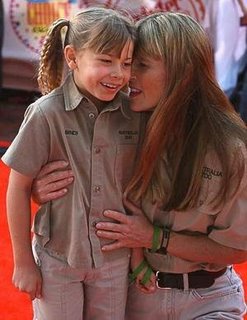
Bindi Irwin and mum Terri Irwin at the Nickelodeon Kids Choice Awards

The results to Question 3 confirmed that indeed I'm not alone in only discovering this little miss sunshine in recent times. Bindi made such a beautiful speech at her dad's funeral. Having taped the funeral – I even took out the ads – I often return again and again to Bindi's performance, the svengali in me recognising I could make a wad of cash if I kidnapped her and set her loose on the stage. Perhaps she could be the opening act for Kylie's Showgirl tour? Bindi could at least read from Kylie's new children's book. Such instincts to exploit this little girl have simply become commonsense. When you're born into the media, you perform or be damned.

Presenting Guy Sebastian the Favourite Australian Artist award at the Nickelodeon Kids' Choice Awards, Bindi in her now customary khakis and crimped pigtails, ate up the stage. "Isn't this great?" Bindi said. "I'm the smallest presenter but I get to give the biggest award." When the Awards climaxed with a big slime fight that saw Bindi, Guy and the hysterical tweeny audience smeared in all shades of green, I just knew Steve would have been proud of his number one girl. If you haven't achieved a televised slime fight in your life so far, then you basically haven't achieved anything.

But all this fame has an ethical dimension when one is so young and thrust into a spotlight rendered brighter since the death of a famous parent. Headlines have been preempting what will obviously take place: Bindi Irwin will be a big star. Despite psychologists like
Alison Garton voicing concern over Bindi's emotional or psychological wellbeing amidst the turmoil of losing dad, we all know that Bindi's basically hot media property. The Sydney Morning Herald's headline for their report on Bindi's appearance at the Nickelodeon awards: "Make Way for Bindi the Rock Star." Well, she's already a rock star. In today's Sun-Herald, a two page article on "the Bindi debate," reports that she already sings and dances in a band called Bindi and the Crocmen, has her own line of clothing and will debut in a 26-episode pay TV program in the US.

When The Artswipe reported on
JonBenét a few months back, I was implying how the saturated depiction of such kids whose early success is based on their precocious smarts and their ability to perform as apprentice adults, represents a new kind of media sanctioned pornography. The Artswipe is not trying to sound like a moral crusader, far from it. The Artswipe is just sick and tired of how in death we turn fairly vapid celebrities like Steve Irwin into saints. Before his death, he was just another larger-than-life Aussie whose celebrity was based on a kitschy brand of Australiana.

"I don't want Daddy's passion to ever end," said Bindi in her heartfelt eulogy. Dear Bindi, as long as "passion" can be merchandised (just ask Mel Gibson), you'll never have to worry about that. Just keep on wearing your khaki uniform, conforming to a recognisable visual identity that melds humanitarianism and entertainment, and you'll be Daddy's passion incarnate. And when you're 18 and trying to throw off your youthful image, I'll support your decision should you go the way of Nikki Webster, to spray that raunch in
FHM.

As for Question 4 about whether anyone had hurt a
stingray. Nobody admitted to human vs nature vengeance in the admittedly smallish sample of people I randomly asked yesterday at work (don't question my empirical research methodologies, ok). Who would even admit to that shit anyway? Oh that's right, I don't think my vox pop sample featured any of the Steve Irwin fan club freaks, who in avenging their master, are really imagining Germaine Greer's face when trampling all over the poor docile stingray.

Monday, August 21, 2006

The Death of the Artist

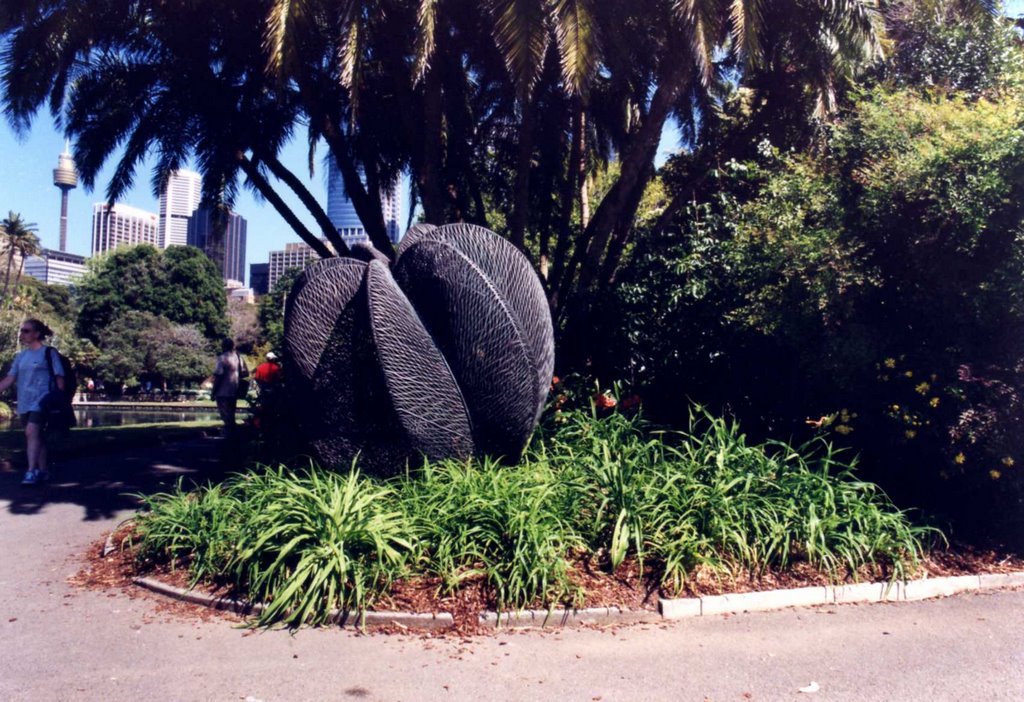
A Bronwyn Oliver sculpture (Photo: The Artswipe)

Though I never met her, the death of Bronwyn Oliver - who on July 11, 2006, took her own life - came as a shock, and filled me with a deep sadness. Images of the Australian sculptor's work started appearing everywhere, and while I have been very familiar with her practice over the years, I started to scrutinise the work on a much deeper level. And I started to feel really, really sad, and filled with a loss that baffled me considering I had not given her work much thought in the past.

Writing in the Sydney Morning Herald - Spectrum (August 19, 2006) John McDonald rightfully claimed: "There is a terrible delicacy in writing about an artist who has recently taken her own life... Whatever one writes about the artist at this time will inevitably stand in the shadow of her death." I couldn't agree more. The intractable scrutiny I experienced in recent weeks while pondering Oliver's oeuvre, is that I find it difficult to shake off the impulse to find evidence, some clue pointing to the mysteries of why she took her own life. But all I find is that terrible, uncanny beauty that she so gracefully extracted from the soft folds of nature and transformed into hard-wired sculpture. It's a line of beauty that has overtaken me somewhat, forcing me to revisit all those artist-as-troubled-genius mythologies we're taught at art school to avoid.

I wandered into Roslyn Oxley9 Gallery on Saturday afternoon to check out Oliver's final solo exhibition and was delighted that the gallery was packed with so many people -- I actually can't remember the last time I visited a gallery with such healthy number of visitors at a time that did not coincide with the free booze of an opening night. I had been putting off visiting Oliver's show, even though it was my intention to pay my respects before the exhibition closed. But a part of me was a bit resistant to attending the exhibition because it would test whether my response to the work would be ideologically knee-jerking my critical faculties into blurring the line between an artist's life and their work. Could I put to the test whether Roland Barthes' "death of the author" argument actually worked when it came to the crunch? Much of the recent press about Oliver has focused on how intensely private, obsessive, hard-working and exact she was. Basically it seems Oliver was a big enigma in the artworld to those who knew the work but didn't know the person, because for starters she was rarely seen schmoozing at flashy Biennale openings and the like. (And I'm guessing most artists see more of each other at openings than they do their art. Unless of course checking out the stills of an artist's current exhibition on their dealer's website has become the equivalent of physically attending an exhibition).

Back to my point. It's precisely because Oliver was such a mystery that her work has been charged with a magnetic force that invites almost morbid speculation: Why did she do it? What could have been so terrible for her to do what she did? Such questions can never be sufficiently answered, so I reckon we should stop asking. But even if we do, it won't stop us from reading her work in ways that cannot but be divorced from knowledge of the death of this particular author. And in a sense that really depresses me. Because I wanted to think I could be more critical than that. I'm not saying Oliver's work doesn't deserve the praise. If anything, her work deserves so much more than our passing tributes punctuated with odd bits of nausea-inducing gossip about the circumstances surrounding her death. It is undeniable that Oliver was a brilliant artist and let's hope she will be admired for generations to come. Such a thought is somewhat optimistic because it means future generations viewing her work may elicit a necessary detachment from the work to set aside for a moment the "shadow of her death" and focus on the aesthetic, conceptual and technical wonders contained therein.

After attending the Roslyn Oxley9 exhibition, it dawned on me that I took a photo of one of Oliver's sculptures years ago -- I think it was 1999 or 2000 -- while doing a Sculpture Walk across Sydney. And while I remember at the time being pretty amazed by Oliver's achievement, the feeling of wonder passed rather quickly because ultimately like most of us I suspect, it wasn't attached to some romantic narrative of the artist's troubled life and death.