Showing posts with label The Sydney Morning Herald. Show all posts

Sunday, November 05, 2006

Reading (RED)


In today's
Sun-Herald – Artswipe's favourite weekend Bible – Bono defends Madonna's decision to adopt David Banda: "I'm very happy that Madonna should offer succour and more than that to a young boy," Bono said. "He's got a great opportunity now." The article goes on to reveal that Bono was once offered an African child by a desperate father, but was unable to take him home. Apparently the boy's face "haunts him to this day" and is the reason Bono started campaigning for African poverty relief. Surely Bono could have taken the boy on as staff? He does employ a whole fleet of people to attend to his family's every need.

Earlier this year Bono and Bobby Shriver, Chairman of Data, created a product line called (RED), which aimed to raise awareness and money for a global fund to help women and children with HIV/AIDS in Africa.
(BLOG) RED documents the journey, which in recent months has seen Gap, Apple, Motorola, Converse, Emporio Armani and American Express release products associated with the (RED) brand. If you buy (RED) you are helping the fight against HIV/AIDS.

Why "red"? Well, in my last post, I suggested – quite crudely I admit – that red and black work quite well together. Red string works on black skin. Even Coca-Cola know they're onto a good thing with their black and red visual identity. The tension the (RED) campaign raises is the way it purports to be about politics, when really it's about aesthetics. Writing about fascism in the epilogue of the famous essay "The Work of Art in the Age of Mechanical Reproduction," Walter Benjamin argues: "All efforts to render politics aesthetic culminate in one thing: war." Bono is certainly not alone today in his attempts to "render politics aesthetic." Much art and popular culture thrives on this instinct, and certainly, Artswipe believes that aesthetics sparkle brighter than ever when charged by the frisson of political engagement – but only when the machinery of propaganda isn't facilitating such processes.

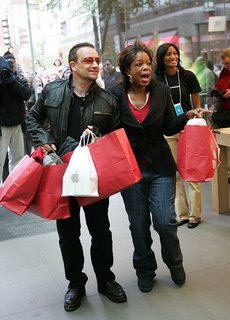
Buy (RED) and we can feel like we're fighting dire social problems like the spread of HIV/AIDS in poverty stricken corners of the globe. Our rampant desire to shop can now feel justified as charity. We're saving the world when we buy a Motorola phone. Can the receipt for a purchase of a (RED) iPod Nano be claimed as a charitable tax deduction? When we spend big on (RED) American Express and get into monstrous debt, does the exorbitant interest charges also go to help Africans with HIV/AIDS? Even Oprah – Artswipe's favourite philosopher (after Walter Benjamin) – champions (RED), taking the time and photo-op to
spend big with Bono. Of course she supports it! Oprah obviously has a major shopping addiction. If "EVERYBODY GETS A CAR!" (as her entire studio audience did in one infamous 2004 episode of her talk show) it's only because she feels compelled to momentarily alleviate her own conspicuous consumption.

Charity begins at home and homes always look better when decked out in a wealth of commodities. Consumed with fervour in the western world such commodities become tokens of cultural, social and even intellectual capital, even if their origins derive from non-western sweat shop labour. (RED) labours under the weight of such good intentions to conflate the frenzy of consumer culture with social responsibility.

Why is it branded "red"? Simply because the issue is not as political as it is aesthetic. As aesthetic as blackness is for a white western culture bred on a Benetton "united colours" mentality. Perhaps signifying blood, which with or without the stigma of HIV/AIDS is still coloured red, the (RED) brand reveals its shallow aestheticisation of race as if it's a Dulux colour chart in its revealing manufacturing of blackness.

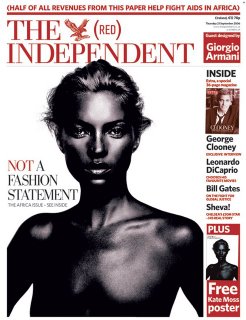
For celebrities endorsing the (RED) campaign, blackness is a commodity that can be purchased symbolically. Through cash register empathy, blackness can be bought to ensure the privilege of whiteness is momentarily used for good. Kate Moss appeared on the cover of the UK magazine The Independent in blackface with the headline, "Not a Fashion Statement." Touted as "The Africa Issue," this September 2006 edition of The Independent was designed as an eye catching tie-in with Bono's (RED) campaign. In her opinion piece for the
Sydney Morning Herald, Emily Maguire writes:

"The stereotypes in these campaigns range from the banal (African equals beads and face paint) to the offensive (Africa equals AIDS). Both contribute to the biggest Western misconception of all: that Africa is a monocultural mess waiting for Westerners to come and clean it up. Africa is a continent, not an issue. AIDS is a disease, not a cause. And while celebrities may believe they are helping by raising awareness, they are, in fact, telling us what we know and creating a false sense that the problem is being addressed."

Maybe The Independent is right: maybe this whole campaign is a worthy cause and "not a fashion statement." Perhaps Madonna had simply purchased everything in the (RED) catalogue to match her red Kaballah accessories, and after a Sunday afternoon bout of consumer fatigue, simply decided babies over brands.

Whatever the case, white bread has never been so (RED).
Monday, August 21, 2006

The Death of the Artist

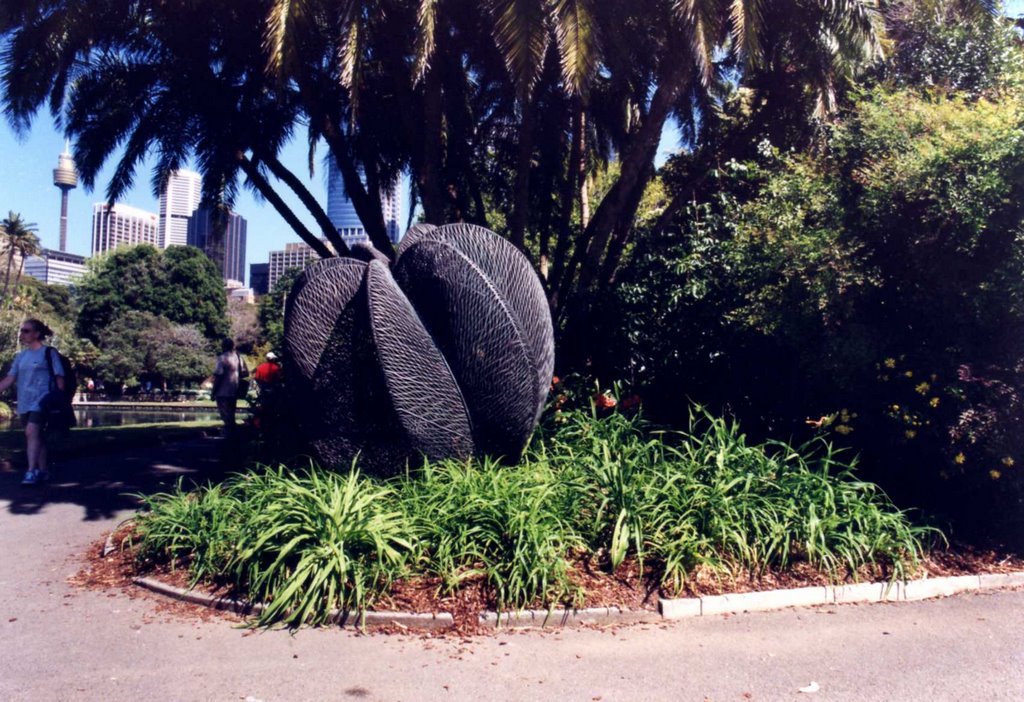
A Bronwyn Oliver sculpture (Photo: The Artswipe)

Though I never met her, the death of Bronwyn Oliver - who on July 11, 2006, took her own life - came as a shock, and filled me with a deep sadness. Images of the Australian sculptor's work started appearing everywhere, and while I have been very familiar with her practice over the years, I started to scrutinise the work on a much deeper level. And I started to feel really, really sad, and filled with a loss that baffled me considering I had not given her work much thought in the past.

Writing in the Sydney Morning Herald - Spectrum (August 19, 2006) John McDonald rightfully claimed: "There is a terrible delicacy in writing about an artist who has recently taken her own life... Whatever one writes about the artist at this time will inevitably stand in the shadow of her death." I couldn't agree more. The intractable scrutiny I experienced in recent weeks while pondering Oliver's oeuvre, is that I find it difficult to shake off the impulse to find evidence, some clue pointing to the mysteries of why she took her own life. But all I find is that terrible, uncanny beauty that she so gracefully extracted from the soft folds of nature and transformed into hard-wired sculpture. It's a line of beauty that has overtaken me somewhat, forcing me to revisit all those artist-as-troubled-genius mythologies we're taught at art school to avoid.

I wandered into Roslyn Oxley9 Gallery on Saturday afternoon to check out Oliver's final solo exhibition and was delighted that the gallery was packed with so many people -- I actually can't remember the last time I visited a gallery with such healthy number of visitors at a time that did not coincide with the free booze of an opening night. I had been putting off visiting Oliver's show, even though it was my intention to pay my respects before the exhibition closed. But a part of me was a bit resistant to attending the exhibition because it would test whether my response to the work would be ideologically knee-jerking my critical faculties into blurring the line between an artist's life and their work. Could I put to the test whether Roland Barthes' "death of the author" argument actually worked when it came to the crunch? Much of the recent press about Oliver has focused on how intensely private, obsessive, hard-working and exact she was. Basically it seems Oliver was a big enigma in the artworld to those who knew the work but didn't know the person, because for starters she was rarely seen schmoozing at flashy Biennale openings and the like. (And I'm guessing most artists see more of each other at openings than they do their art. Unless of course checking out the stills of an artist's current exhibition on their dealer's website has become the equivalent of physically attending an exhibition).

Back to my point. It's precisely because Oliver was such a mystery that her work has been charged with a magnetic force that invites almost morbid speculation: Why did she do it? What could have been so terrible for her to do what she did? Such questions can never be sufficiently answered, so I reckon we should stop asking. But even if we do, it won't stop us from reading her work in ways that cannot but be divorced from knowledge of the death of this particular author. And in a sense that really depresses me. Because I wanted to think I could be more critical than that. I'm not saying Oliver's work doesn't deserve the praise. If anything, her work deserves so much more than our passing tributes punctuated with odd bits of nausea-inducing gossip about the circumstances surrounding her death. It is undeniable that Oliver was a brilliant artist and let's hope she will be admired for generations to come. Such a thought is somewhat optimistic because it means future generations viewing her work may elicit a necessary detachment from the work to set aside for a moment the "shadow of her death" and focus on the aesthetic, conceptual and technical wonders contained therein.

After attending the Roslyn Oxley9 exhibition, it dawned on me that I took a photo of one of Oliver's sculptures years ago -- I think it was 1999 or 2000 -- while doing a Sculpture Walk across Sydney. And while I remember at the time being pretty amazed by Oliver's achievement, the feeling of wonder passed rather quickly because ultimately like most of us I suspect, it wasn't attached to some romantic narrative of the artist's troubled life and death.

Friday, August 18, 2006

God Grant Me the Semitic


John Waters, Straight, 1996
John Waters is represented by
Arthur Roger Gallery in New Orleans, Greg Kucera Gallery in Seattle, and probably others.

So let's turn to "recent world events." Mel Gibson has been ordered to say his "God grant me the serenitys" at Alcoholics Anonymous meetings five times a week for four and a half months and three AA meetings per week for another seven and a half months. He's also been ordered to enrol in an alcohol-abuse program for three months, fined a paltry sum of $US1,300 ($AU1,694) and had his licence restricted for 90 days.

I'm a bit pissed off by all of this actually. Mel Gibson shouldn't be punished for drinking - this actually makes him bearable. Rather, he should be punished for his crimes towards cinema. Just imagine how much of better place this world would be if we'd never had to witness Maverick, What Women Want and The Man Who Got Off His Face? Of course, if bad cinema doesn't make him punishable, then the whole anti-Semite thing should put him up there on the "naughty shelf" with all the war criminals. Writing in the
Sydney Morning Herald (August 11, 2006) playwright Louis Nowra claimed that the media's attacks on Gibson were "sanctimonious," "blown out of all proportion" and "shows a disturbing trend in this era of media witch-hunts." I disagree, Mr Nowra. It's a sink or swim situation out there in celebrityland and a good-old-fashioned witch-hunt rekindles our literal joy in hanging the witch if they don't drown first in their own vodka vomit.

Maybe I'm being just as hateful as Mel. Actually no one could be. The notorious film director John Waters (Pink Flamingos, Polyester, Hairspray) once exhibited a photo (yes, he takes photos of TV screens) about Mel's apparent hatred of gays. Is there anyone Mel don't like?

As Waters writes in his book of art photos, Director's Cut (Scalo, 1997): "Of course I can be hateful if I'm pushed... [On] Mel Gibson: Don't get me started on his homophobia. One shot of his name, matted crookedly and entitled Straight (1996) says it all as far as I'm concerned."

Friday, August 04, 2006

Lady Flattery

Tracey Moffatt
(photo by Steven Siewert from The Sydney Morning Herald)

Recently The Sydney Morning Herald reported that Tracey Moffatt, the glorious doyenne of art glamour, is making a new series of portraits of artworld figures and celebrities that will flatter all involved, "making them appear 20 years younger." If anyone can pull this off, it's Ms Moffatt because she understands better than anyone that a polished aesthetic is the secret to eternal youth. And for Moffatt, Photoshop covers over a multitude of skins – I mean sins – associated with aging. I wondered if maybe she wouldn't mind taking a portrait of Kathleen Turner, because the poor thing didn't take too kindly to age. In the eighties, when Turner ruled Hollywood, the age-youth-beauty nexus was basically branded by Turner's face. Now darling KT is all alone in a young, beautiful world ruled by whoreskanks like Lindsay Lohan. Actually, maybe Ms Moffatt could take a portrait of Lohan because 20 years younger and she'd appear all fetal, and that's my favourite look this season.