Friday, October 27, 2006

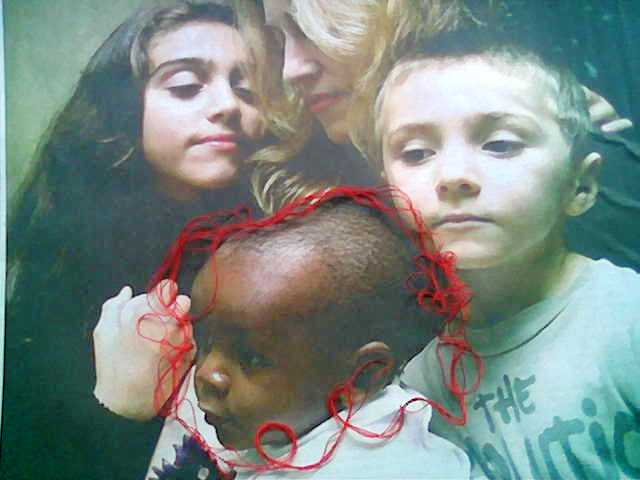
Red String for Baby David

The Artswipe
Red String for Baby David, the New Kaballah King
Mixed Media, 2006


The Artswipe never makes it a recurring practice to namedrop but sometimes you just gotta. So here goes... Madonna is actually one of my best friends. OK, there, I've said it. Let's just now move on. To prove it: Madonna is actually No 1 on my speed-dial. Madonna and I have been friends for years. I choreographed those conveyor belt moves seen in one of her late eighties tours. And now I'm in line to be a diasporic godparent.

Madonna has been calling intermittently throughout the year, telling me to "up" my platform: "Move beyond the blog and start a talkshow you fool!" She's always on my case about that, and I always reply: "When you start adding Australia to your tours, Bitch!" Anyway, we always have that kind of banter. But I must admit, she's always crapping on about how far away Australia is, but she never complains about going to Africa if she can pick up a tasty souvenir or two. Sometimes our best friends are really our worst enemies.

To my surprise, I received an email from Guy Ritchie this morning. When the husband is emailing you behind the wife's back, something's definitely up. It's no secret; Guy and I have never really gelled. He's basically a talentless, whinging pom and he's jealous of my relationship with Madonna. He hates anyone who has a longer history with his wife than him. When they got hitched I begged her not to marry him. I even photoshopped Guy in bed with Tom Cruise, but really should have used a pic of Guy that she wouldn't recognise – like one she hadn't actually taken during their honeymoon and emailed to, like, everyone.

So Guy emails me and it was very revealing: "Madge really hates Oprah - she's called Oprah a condescending motherfucker this morning while Nanny No 3 was within earshot changing baby David's nappy. You know, once when Madge was on her show, Oprah waited for the ad-break to tell Madge that she'd never earn as much money as her. Madge fired back: 'Once a fattie, always a fattie!' When the ad-break ended they smiled for the cameras, hugged and shed a few tears while a moving Gregorian Chant version of 'Holiday' played over a slide show featuring never-before-seen polaroids of Madge's dead mother. It was actually a great TV moment and made me think of directing some TV one day. But Artswipe, if Oprah wasn't black, Madge wouldn't have bothered defending the recent media tirade on her stage. But black is our favourite colour this year and Oprah has topped the black charts for years now…"

I was actually surprised that Guy could string a sentence together. His talent obviously knows no bounds. He is a writer/director, after all. After more rambling, he basically confessed that they adopted David because some Kaballah mystic said it would be good for the faith to get more multicultural and that red string works quite nicely on black skin. He signed off by apologising for being a cunt to me over the years and pleading for Artswipe to put some positive spin on their adoption situation.

Well, I can't promise anything. Rome wasn't built in a day, and Hollywood certainly wasn't overtaken by Kaballah propaganda overnight. These things take time. But I really do support their decision to adopt David. Celebrities always look much better when they have a trophy from poverty stricken or war-torn parts. Mia Farrow knew once she made a name for herself in Rosemary's Baby all those years ago that her future babies would never glisten with the Satan-like connotations of whitemeat. Angelina Jolie hands-down wins the Artswipe award for best combined family haircut. And speaking of trophies, Madonna knows more than anyone that black babies are more than just accessories, especially when they're destined for a life of being dressed by Dolce & Gabbana.

It's not the first time Madonna has expressed a desire to mother black "children." Throughout In Bed with Madonna, she goes on about how her she mothers her black gayboy dancers "out of the need in me to be mothered." She was then, quite simply destined to one day have a black baby of her own, to teach him to vogue some of those low-down drrrty Motown moves. Madonna, more than anyone, knows how to manufacture sizzling shit-hot authenticity out of the most base cross-cultural cliches.

So I say: Leave Madonna alone. Kaballah obviously needs the numbers, if not a new poster chile.

Wednesday, October 18, 2006

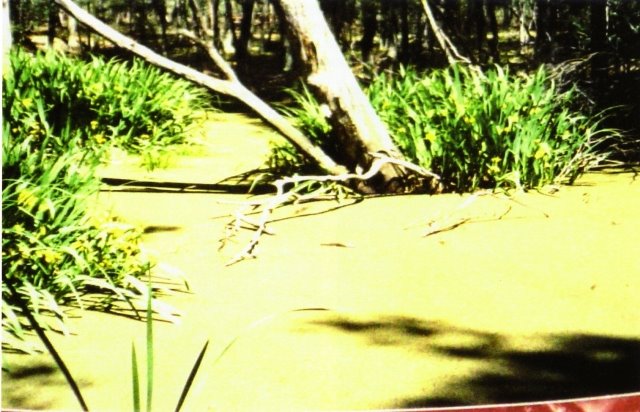
Swamped


Sarah Goffman
Kingswood Swamp, 2004
From Alien Invasion,
MOP Projects catalogue, 2005
Courtesy of the artist and MOP Projects


It's no secret, Artswipe gets pathetically nostalgic for art school life all the time. Oh those were the days. I recall the good times, sitting around in circles biting each others' heads off (or giving some good old fashioned art school head) in "crits" while the lecturers swanned around reminding the kids that art is hard so get used to it!

You can probably imagine then, the anguish I have been experiencing in recent weeks with all this bullshit about the National Art School's potential merger with the College of Fine Arts and the closing down of the University of Western Sydney's fine arts and electronic arts programs.

Where will the kids go to make art? Is it a coincidence that
anti-sedition is all the rage with the Howard government at the same time art schools are a dying breed? Sedition laws, which significantly impact artists, were passed less than a year ago, and now art is being threatened again in a way that's linked to the government. The lifeblood of the arts – its government funded university art schools – are under threat. Higher education itself has never been part of Howard's agenda. Adequate funding to keep alive a culture of educated types is just not relevant in a country that, for instance, celebrates Steve Irwin and shuns Germaine Greer. If Greer gets stung by a bee, has a severe reaction and dies, will her funeral be televised? Will people avenge her by killing all the bees?

The brilliant thing about NAS and COFA is they are such dynamically different institutions. I'm not going to play favourites and say one has a better approach to art education because they both excel in their own unique ways. As for UWS, well that place produces art student powder kegs who come from the west or choose the west for their art education. I've fantasised many a time of what it must be like to make art in the west, or at least show at Casula Powerhouse. Casula features in most of my dark fantasies because Ivan Millat once drove through there picking up a hitchiker. In one of my favourite night sweats, I am a conscientious citizen who jots down the number plate, goes home and paints it, acrylic on canvas.

Oh and all the fantasies I could conjure about UWS. All those parklands surrounding the vast campus. Artswipe would never catch a train all the way to Kingswood without being guaranteed some good old fashioned date rape in those dark woods. So basically I'm yet to catch that train. I mean, really, the Kingswood campus even has a fucking swamp! And the swamp's inspired artists like Tracey Moffatt and Sarah Goffman to make art and I'm pretty sure they didn't study art at UWS. Basically a university with a swamp needs an art school attached to it. Mandatory.

Tracey Moffatt
Artist at Work, 1997
(represented in Sydney by Roslyn Oxley9 Gallery)

Swamps bring out the Julia Kristeva in all of us and it's at art school we read that wonderful book, The Powers of Horror: An Essay on Abjection (1982). My favourite line: "During that course in which 'I' become, I give birth to myself amid the violence of sobs, of vomit" (emphasis added). While Kristeva wasn't talking about an art course per se, she may as well accept the fact that we all read this at art school and it became the mess mantra. Remember that old saying that there's a time for everything under the sun? Well, that includes having your perfunctory grunge period, where you go all abject and degenerate, piss all over the car park, photograph it, photocopy the photograph, post it on the noticeboard (the one which is only read by engineering students) and document it all over again but this time with whatever body fluid is your favourite that week. When I went through my grunge period, dandruff was my medium because I was saving my body fluids in a time capsule. The Powers of Horror was my textbook - I was really getting into subverting boundaries, borders and binaries - and I paid enough in library late fines to have been able to buy at least three copies of it.

Well, art school date rape has taken on new highs because it seems UWS has been raped and pillaged of its esteemed arts programs. Sari Kivinen, who was a shortlisted for the 2006 Helen Lempriere Traveling Art Scholarship and reviewed in an earlier Artswipe post (you might remember Sari drinking her multiple personalities under the table, or at least in the kitchen sink) is spokesperson for the blog Save UWS Arts and internet petition. Organised by UWS students, the blog and petition are gaining much momentum and support, which is great. Stay tuned for protests - if you're lucky they may even take place at the campus bar, which I'm told is called The Swamp Bar.

Sunday, October 15, 2006

Crocodile Tears


Steve Irwin in Toyota advertisement (2004)

Since Steve Irwin's death, The Artswipe has been engaged in some unofficial vox pop, hitting the streets with a series of really important questions:

1. Did you cry when Steve Irwin died?
2. Did you give a shit about Steve Irwin before he died?
3. What will become of Bindi Irwin?
4. Have you hurt a stingray in the last month?

The answers yielded interesting results. Regarding Question 1, the general consensus was people were devastated their great cultural icon had gone. Not everyone cried, because since Diana, it's been hard to make celebrity grief meaningful. With Question 2, the results were certainly mixed, with most people saying they were so proud of his accomplishments they considered him one of the family. Very few confessed to not liking Irwin before he died, and feeling a tad guilty now he was in celebrity heaven. One angry dame spat in my face for using the word "shit" in the same sentence as "Steve Irwin." Someone's gotta tackle the big issues, lady!

With Question 3 things get really complex. Before Steve Irwin's death, The Artswipe didn't know about eight-year-old Bindi Irwin, having been indifferent to popular culture founded on crocodile cowboys like Hoges and Irwin. Their careers are crassly commercialised clichés made with American audiences in mind. Steve Irwin's fame was rock solid in the US long before it took off here in Australia. It seems Australians only gave a shit about Irwin after he'd been validated by Americans. If a celebrity's image is founded on a renegade touristy stereotype, then how can it have any relevance or authenticity in its originating country? That Irwin had reared a media savvy, delightfully named, crocodile huntress in Bindi had simply escaped me. I was too busy coming to terms with the fact that people eat this myth with a spoon: man tames beast in rugged terrain, film it for network television, package it with merchandising and charity causes. Erase all signs of big dollar network mediation, emphasise how Irwin was actually doing worthy work (helping sick animals and the like) and what you have is instant hit validated by one and all. When Germaine Greer gets on her soapbox, the media jumps on her, reminding everyone she's a cranky old bitch. What would Germaine know? She's an ex-pat which makes her an instant traitor. Despite her wacky ways, she's basically a signifier of any vestiges of intellectual culture Australia has ever produced. Therefore, she is discredited immediately. What would a pioneering radical feminist scholar know? Nothing if her work is not perpetuating cultural dumbness.

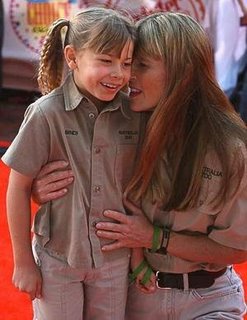
Bindi Irwin and mum Terri Irwin at the Nickelodeon Kids Choice Awards

The results to Question 3 confirmed that indeed I'm not alone in only discovering this little miss sunshine in recent times. Bindi made such a beautiful speech at her dad's funeral. Having taped the funeral – I even took out the ads – I often return again and again to Bindi's performance, the svengali in me recognising I could make a wad of cash if I kidnapped her and set her loose on the stage. Perhaps she could be the opening act for Kylie's Showgirl tour? Bindi could at least read from Kylie's new children's book. Such instincts to exploit this little girl have simply become commonsense. When you're born into the media, you perform or be damned.

Presenting Guy Sebastian the Favourite Australian Artist award at the Nickelodeon Kids' Choice Awards, Bindi in her now customary khakis and crimped pigtails, ate up the stage. "Isn't this great?" Bindi said. "I'm the smallest presenter but I get to give the biggest award." When the Awards climaxed with a big slime fight that saw Bindi, Guy and the hysterical tweeny audience smeared in all shades of green, I just knew Steve would have been proud of his number one girl. If you haven't achieved a televised slime fight in your life so far, then you basically haven't achieved anything.

But all this fame has an ethical dimension when one is so young and thrust into a spotlight rendered brighter since the death of a famous parent. Headlines have been preempting what will obviously take place: Bindi Irwin will be a big star. Despite psychologists like
Alison Garton voicing concern over Bindi's emotional or psychological wellbeing amidst the turmoil of losing dad, we all know that Bindi's basically hot media property. The Sydney Morning Herald's headline for their report on Bindi's appearance at the Nickelodeon awards: "Make Way for Bindi the Rock Star." Well, she's already a rock star. In today's Sun-Herald, a two page article on "the Bindi debate," reports that she already sings and dances in a band called Bindi and the Crocmen, has her own line of clothing and will debut in a 26-episode pay TV program in the US.

When The Artswipe reported on
JonBenét a few months back, I was implying how the saturated depiction of such kids whose early success is based on their precocious smarts and their ability to perform as apprentice adults, represents a new kind of media sanctioned pornography. The Artswipe is not trying to sound like a moral crusader, far from it. The Artswipe is just sick and tired of how in death we turn fairly vapid celebrities like Steve Irwin into saints. Before his death, he was just another larger-than-life Aussie whose celebrity was based on a kitschy brand of Australiana.

"I don't want Daddy's passion to ever end," said Bindi in her heartfelt eulogy. Dear Bindi, as long as "passion" can be merchandised (just ask Mel Gibson), you'll never have to worry about that. Just keep on wearing your khaki uniform, conforming to a recognisable visual identity that melds humanitarianism and entertainment, and you'll be Daddy's passion incarnate. And when you're 18 and trying to throw off your youthful image, I'll support your decision should you go the way of Nikki Webster, to spray that raunch in
FHM.

As for Question 4 about whether anyone had hurt a
stingray. Nobody admitted to human vs nature vengeance in the admittedly smallish sample of people I randomly asked yesterday at work (don't question my empirical research methodologies, ok). Who would even admit to that shit anyway? Oh that's right, I don't think my vox pop sample featured any of the Steve Irwin fan club freaks, who in avenging their master, are really imagining Germaine Greer's face when trampling all over the poor docile stingray.

Monday, October 02, 2006

Art Satan

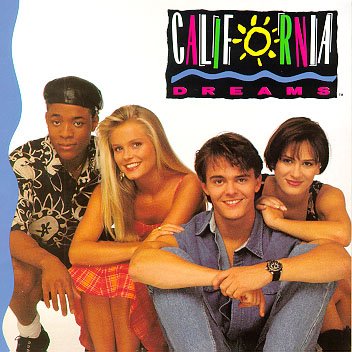
California Dreams (pre-Philip Brophy makeover)


I'm becoming very predictable. Really, I never thought I'd write another Artswipe post citing the gorgeous man of all things glam -

Philip Brophy. As he's showing at a post-Lempriere Artspace, and there's really not that much else on, I couldn't help but dedicate this next song to Philip.

Featuring three solo projects by seemingly divergent artists, Artspace is like one big salad at the moment. To the left is Gary Carsley doing his drag/daguerreotype thing sealed with a fairly innocuous but knowing reference to Björk's least interesting song "Venus as a Boy". (Note to self: I must get to the fucking Chauvel and see Drawing Restraint... I must also recharge my iPod). In the middle of Artspace, as one enters the gallery is Maria Cruz, that zany den mother of the monochromatic moment unofficially paying tribute to my favourite game: Million Bucks (and everyone has to know). It's a variation of Pin the Tail on the Donkey. You close your eyes, point to someone ugly in the street and that's the next person you have to have sex with. And everyone has to know. In return you get a million bucks. This game is aka Charity Fuck. Actually, that's not at all what Cruz's work is about, but that's my interpretation and I'm sticking to it.

Performance art moment: Skanky Jane puts a blindfold on Artswipe. Spin around. Of course the blindfold is made out of organza, so Artswipe gets to sit pretty looking down on all creation. At that moment Artswipe knows everything and has power over what's hot and what's not. Biopower, actually. Kant incarnate mulling over the colour chart of life, Artswipe decides what images will be heritage-listed this season. Point and fuck. And if everyone has to know about it, then that's cool because the Press Release is Artswipe's favourite literary genre right now.

Who do I point at? Philip Brophy: Art Satan.

Turn right at Maria Cruz and Brophy's Evaporated Music 2: At the Mouth of Metal is playing. Actually, walk into Artspace and his Dolby 5.1 "aural surgery" can be heard contaminating the whole Gunnery like acne spreading its putrefied pointillism teen crackwhore style. A scene from the early '90s TV show California Dreams is given a Brophy metal remix. I don't recall California Dreams, but it gives off a kind of Hillsong vibe in its peachy pastel glaze of righteous rock.

File under: Inspirational.

In his artist statement, Brophy writes: "Like Satan summoned in the middle of the high school prom, Evaporated Music 2 rescores these vapid TV studio-floor moments with the sound of Metal. Think Disney riddled with cancer. The Wiggles sweating with Hep B. Evaporated Music 2 welcomes the most Other of music – Metal – and amplifies its guttural explosions through the healthy bodies of television's dream of contented pop music."

With hands raised, not to the Lord, but
Lordi (the Finnish monster mash maelstrom who won the 2006 Eurovision Song Contest) Brophy's taped-off-tv loop of California Dreams (with its, I think it was Channel 7, watermark still intact) is a glittering tribute to what might happen if Delta Goodrem was raped by a crate of ice cold Pepsi dildos.

Lordi.

Friday, September 22, 2006

Punch Drunk


Sari TM Kivinen
Drunk in the Kitchen Sink Again, video, 2006
Courtesy of the artist and Artspace.

The Art Life has done it again. "What did the Team do?" I hear you ask. "Beat me to the punch with an overview of the Art Award love-in circus currently spreading like a sexually transmitted hybrid media disease." If I ever get around to writing an art theory book, it will be an ethnographic tell-all memoir about how awards have been passed down from ancient civilizations to ensure marginal culture groups (like the artworld) have the opportunity to have a burger named after them at the Burger Bun. And it's about time: there's only so many Logies, Oscars and Aria Awards you can eat. Now artists can stop pretending they'd prefer Sushi Train and feel justified going down to a local food court and purchasing a "Lempriere, hold the lettuce." Primavera artist Julia de Ville would be working in the kitchen making all sorts of taxidermy treasures from the mince patties before they made their way to the bun.

I always thought art was too cool for words, let alone awards. Awards are tres tragic and that's why we use awards ceremonies as a good excuse for a party. For instance, last time the Emmy Awards were on, I had to watch with a bunch a friends and a case of champagne, if only to perform a taxonomic analysis of how many times Hollywood celebrities like Rachel Griffiths and Christina Applegate were sprung turning up to the same do in the same dress.

Well that's exactly what happened to me at the Primavera and Helen Lempriere opening nights held recently at the Museum of Contemporary Art and Artspace respectively. I turned up both nights wearing the same dress as a very famous art star, whose name I cannot divulge. (You know who you are, bitch!) But true to form I had too much to drink after only an hour or so and spewed Burger Bun chunks all over my Lisa Ho. Never mind, I always have a change of clothes underneath – just in case. Seeing I had not yet invented my Twin Towers costume, the spare change was this slinky denim corset, beaded with "glitter licks" (my term) and hemmed with a deconstructed Tsubi like stitching. Where the fuck is my award for even documenting such minutia, such ephemera, such low down, top grade grandeur?

But no, awards don't come easily when the sun comes up the next morning and you realise your friends haven't SMS'd you in like twenty minutes. You've been dropped. They are too embarrassed to be called your friend, even though they need you because you're a more important artist than they are. It is you who is always being shortlisted – not such much for awards than for jobs at Ikea – but never mind, you've used a few tan-coloured coffee tables in your installation art from time to time to make the whole application process worthwhile. It's when those same "friends" make a beeline for the other side of the street while holding Zanny Begg inspired placards that read "BEING DRUNK IS NOT PERFORMANCE ART." And on the other side of the placard, Mitch Cairns has rendered your image - all nervous line work and naive stylings in vomit coloured crayons. OK, so maybe now I am sounding like that anonymous SLUT who had the nerve on my own comment forum to call me "a spoiled brat" for dissing the Biennale volunteer slave drive. Actually s/he may just be right.


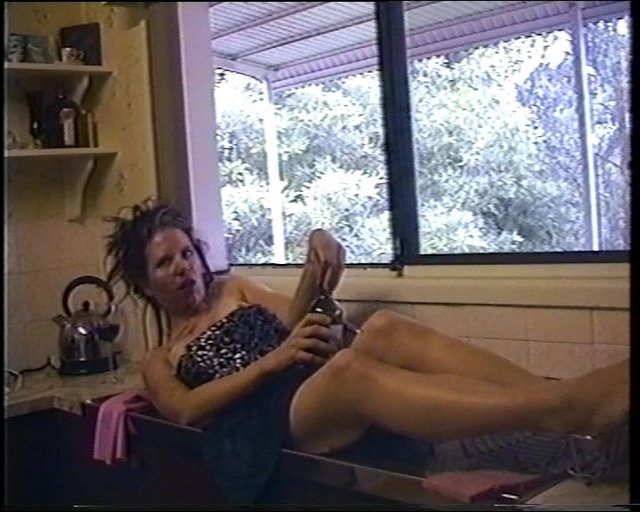
But what is that I see over there, shining its data-projected light onto an Artspace wall? It's Sari TM Kivinen, emerging star of the dark night. The Art Life made brief mention to this little vixen of the yard glass, and I'd like to take the opportunity to elaborate. Frankly, I'd like to thank Kivinen for showing me the way. In her video Drunk in the Kitchen Sink Again, Kivinen does something no one really does anymore: make work about being drunk rather than actually assuming alcohol is an artist's natural adjunct (with or without awards).

In the video, Kivinen sits in the sink manufacturing a slow building intensity that erupts in a train of rabid affects. Seducing with a sweet smile or a butterfly lullaby before growling like a Diamanda Galas banshee gripping the wine bottle in a tightfisted presidential handshake, Kivinen's video climaxes in a fit of "low-fi" toe-eating self-loathing. Searching for this Kivinen lady online to see who she is, what she's on about, and how I can join her AA group, I stumbled on her
website, which details a whole sordid backstory spun around three fictional characters called Jessee-Liina, Caroliina and Starella. Sisters with a hereditary weakness to alcohol, they can be socialites with a taste for the sherry bottle (as in Jessee-Liina, who is seen on the website cavorting with those gorgeous think-pink-tanks, The Motel Sisters) or Caroliina, who is a jealous tipsy bitch unstuck by Jessee-Liina's popularity, or Starella, the mad one who gets all downward spiral on the piss. Starella is so troubled, she bathes in a fruity punch polluted by her own weeping mascara.

Kivinen writes:

"Starella is the youngest of the Liina sisters. Armed with a mean temper Starella often appears out of control and out of sync with this world. As the youngest Starella is infinitely influenced by sister Caroliina's drinking habits- taking it ten folds over the limit without a care about what anybody thinks.

"Starella often comes across like a wild animal caged and confused, however she is completely aware and in control of this primal impression and finds strength in her out of control behaviour and uses this image to protect her true self from the harsh opinions of her older sisters. Starella relishes embracing her own demons and enjoys the fun of never knowing where she’s gonna wake up next."

So I am assuming it's Starella making the appearance in Kivinen's compelling Lempriere video. Or could it be Kivinen after all, muckraking certain reality/fiction distinctions? As her website explains, "Most importantly, Kivinen explores her own fears of becoming an alcoholic, due to her own genetic predisposition. She does this by passing the buck to her characters by exploring how the sisters individually deal with their alcoholic genes."

Now I am totally convinced: Kivinen deserved the Lempriere award because she brings a refreshing honesty to her practice that I haven't seen in years, one that makes me long for sobriety (and then discard that longing as a form of false consciousness). Furthermore, I just know that Kivinen would have used the money for more "art supplies" - the liquid kind.

Wednesday, September 20, 2006

Terrorism Fatigue


Nine days have passed since the five year anniversary of the September 11 attacks on the World Trade Centre. In those days I have been tossing around the idea of going all social comment on my readers. (Social comment art, after all, is my favourite kind of art and Art Express my favourite annual art exhibition - those art kids know a thing or two about politics). Anyway, can I tackle the twin towers?

I woke up early on 9/11 five years on. Switched on the plasma. Sat narcotised by the looped terror footage. Realised I like short sentences. Decided to call in sick.

"Are you sick?" asked Marcy, the receptionist at work.
"I've come down with terrorism fatigue."
"Oh darl, I know what that's like. If there's anything we can do to help please let us know. We are here for you."

I hung up the phone and put on some Enya to calm my nerves. Valium's never been my thing. A plane flew overhead, vibrating the windows of my house – something I've never noticed as much as accepted, living as I do under a flight path. Gotta move - planes might start falling from the sky and I can't afford house and contents insurance being an artist whose medium right now is the blog. Does that make me new media? Searching through old boxes of old media – VHS to be precise – I found what I was looking for: La Bamba. That scene where the plane crashes in the sky has been like my favourite image since like forever. It has a strangely calming effect – more calming at least than the horror that Lou Diamond Phillips was never a bigger star. Para bailar la Bamba Para bailar la Bamba.

After playing the scene is all kinds of motion – fast, slow, freeze frame, reverse – I switched it off just in time for an episode of Oprah. Thank the Lord for the W channel. Makes my Foxtel subscription worthwhile. This will be the third post where I mention Oprah. Well, dear readers, if you haven't realised by now, she is my favourite female artist after Tracey Emin. Interviewing a 9/11 widow who was paid millions in compo, but then became a big consumer whore much to the chagrin of American taxpayers, Oprah turned to the audience, and said "You have a hole in your soul." The 9/11 widow just nodded, a lonely tear trickling down her botoxed cheekbone before confessing she now throws up after a spending spree. Bulimia has taken new shape. Never one to let a moment pass by without acknowledging what a fattie she once was, Oprah reminded us that, had she lost Steadman to 9/11, she'd have eaten her pain.

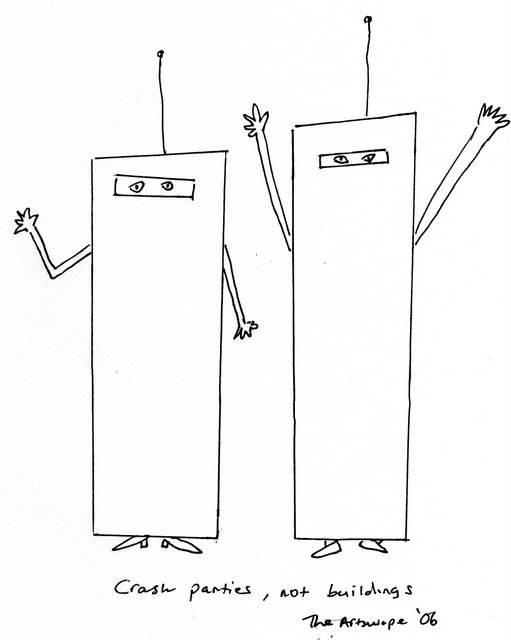
"Hardly a day goes by when I don't think about 9/11. It's mainly when I'm getting dressed in the morning that I think about the 3000 who died," said Oprah to her nodding audience of buffed upper middle class whiteys. At that moment, I switched off the plasma, rewound my copy of La Bamba, and got out the art supplies to make some post 9/11 art. Culture is so post 9/11 right now and if I don't make something to secure my relevance then I may as well never apply for OzCo funding again. Using cardboard boxes, I replicated the towers as costumes to wear next time my performance art collaborator helps me crash an art party or two. This piece is called:

Crash parties, not buildings (2006)
Mixed media
POA

Friday, September 15, 2006

Identity Politics


Artswipe has been flooded with fan mail of late. Bags of it. Weekdays at approximately 3:27pm my favourite postie, Maxine, arrives on my doorstep to unload those canvas sacks. It's around the same time of day that the kids in the neighbourhood walk home from school, occasionally stopping to play hopscotch, trade marbles and compare Nike logos. I might paint that image one day. In oils.

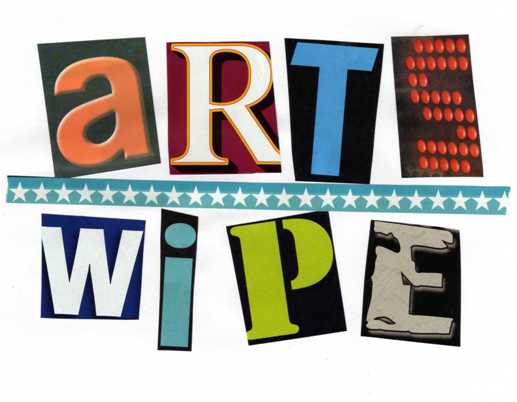
The recurring questions my fans ask: "Who are you?" and "What do you look like?" As I stopped buying letter-writing stationary around the time I signed up to Blogspot dot com, I thought I'd reply en mass with a little lesson about identity politics and a collage I made of my name.

Identity is never singular, never constant and is in continual flux. In contrast, a dictionary I consulted defines identity as "the state of being identical or absolutely the same; selfsameness of character or quality."

I prefer flux - or Fluxus, to use her full name.

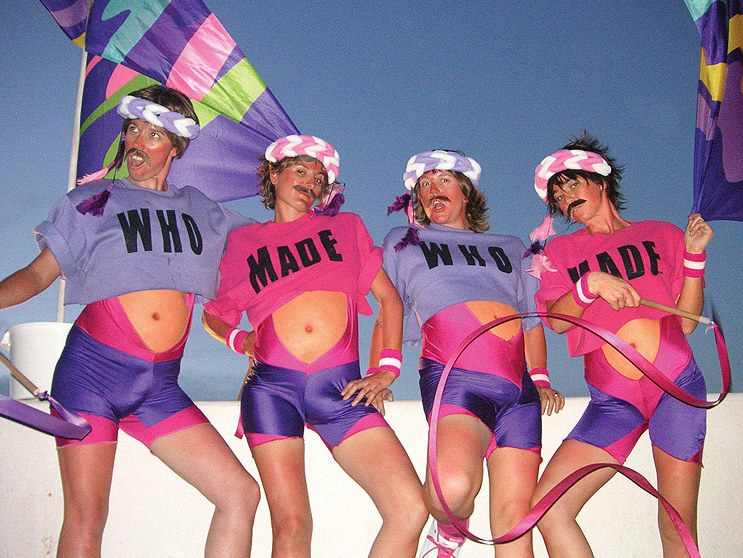
Strange as it sounds, people regularly consult my homespun take on identity politics. I always use the medium of dance (genre: contemporary) to demonstrate identity's multiplicity because I guess none of us really understood Judith Butler's work, but carry on regardless, daily debating "performativity" at the office watercooler.

My backup dance troop, The Hegemony Dancers, accompany my act (when they're not touring the Westfield circuit). Today we promise to make meaning like never before.

Tuesday, September 12, 2006

See Anything Suspicious

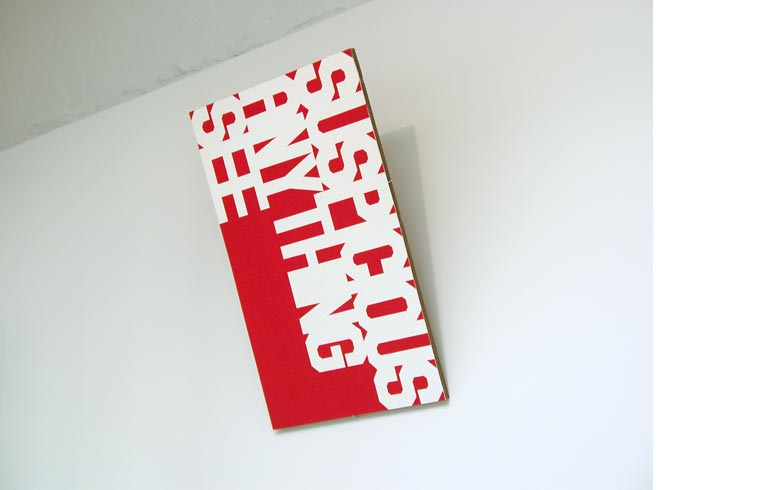
Rose Nolan
SEE ANYTHING SUSPICIOUS, 2006
(Sourced from Sarah Cottier Gallery website)

Welcome back Sarah Cottier Gallery. Elegance returns yet again to the Sydney artscape. Reading an article in the latest Australian Art Collector (issue 27) which interviewed Sarah about the re-opening of her gallery, I experienced a curious sensation of porous nostlagia. As you all know, Artswipe lives for nostalgia, so the news about Sarah's new chic Paddington digs just took me back to those heady days in Newtown (November 1993 - April 1997) when Sarah (and partner Ashley Barber) reigned supreme with a stable of artists that included the likes of Mikala Dwyer, Hany Armanious and Matthys Gerber. When Sarah exhibited Sylvie Fleury's haute-couture rocket ship in December 1994 I was in some kind of transubstantiated heaven. Then they moved to a very epic space in Redfern (December 1998 - November 2003). It was there I got dizzy in John Nixon's monochromes and Maria Cruz's cryptic word play.

So an email is forwarded to me a few weeks ago from an Artswipe fan. Attached is a PDF invite to view the first Sarah Cottier phase three exhibition featuring work by Simon Barney, Stephen Bram, Marco Fusinato, Matthys Gerber, Rueben Keehan, John Nixon, Rose Nolan, Elizabeth Pulie, Andreas Reiter Raabe, Koji Ryui, Gemma Smith and John Spiteri.

Cool. Love them all. Can't wait for the opening. Artswipe, like all serious bloggers, is a major art opening fuckslut. You could never ever know how disappointed I was when I read the next line of the feline-grey-type-on-white-PDF, which said "No opening, but we're open."

Surely, that can't be true. How could I possibly attend during gallery hours? The thought of going to an exhibition and not seeing the work through a haze of overcrowded piss-elegance is just too impossible to fathom. How could I actually claim to have seen art in its true context: through a filter of air kisses, knowing nods, art market mayhem, Fiorelli fashion frenzies, literacies in text-art alliteration.

"Turn your frown upside down," said my therapist when I bared my heart and soul during one vulnerable hour of psychic power. "Being seen at art openings speaks to your inability to let go of being seen seeing, looking at being looked at, among many other cross pollinating circuits of spectatorial desire … And really, you can always go to the Primavera opening." It wasn't until much later that I realised how my therapist, once again, couldn't be more on the money. It's like my therapist looked into my black little heart and saw a desperate pit of nothingness consumed by viewing art through a scrim of mass body contact. Shame on me for being so into group dynamics.

How did I become such a fucking mess? Where did life begin, where does it end if not for a few quality opening nights lightly salted with some shit hot abstraction? How am I expected to engage with meaning without feeling part of a mingling audience that rims the champagne glass of light and dark, court and spark? Never one to brave my own paranoia that serious art commentary is best served with crab cakes and wasabi peas, I decided to visit the gallery, braving the white walls, fearing the slow burning echo of my own shallow presence. And low and behold, Rose Nolan, that brave pioneer of all things red and white, said with finite clarity in three words what most of say in at least ten:

See Anything Suspicious

Sunday, September 10, 2006

Stupid as a Blogger


Rolando Caputo & Juan Davila, Cine-Romance, 1983
Frame from Super 8 Film

I stepped into the post-Biennale, pre-Primavera Museum of Contemporary Art today to reacquaint myself with the work of Juan Davila. Seeing Davila's work again made me nostalgic for the art that made me want to be an artist. Is there anyone out there these days with a fire in their belly not unstuck by the hybridity-flavoured bubblegum that masquerades as identity art? Why at this sudden juncture am I nostalgic for the brash postmodernism of Davila's generation? Oh the glory days when there was a Super 8 collective rather than art made by mobile phones. And just to illustrate my thesis, pictured here thanks to my Nokia mobile, is a still from Juan Davila's brilliant Super 8 collaboration with Rolando Caputo, Cine-Romance (a work not featured in the exhibition).

Art today still seeks recourse to the familiar politics of identity facilitated by postmodernism and certainly evidenced by the MCA's earlier exhibition Masquerade (23 March - 21 May 2006). But perhaps the politics stay the same while the art often loses its edge? I miss the days when art forcefully engaged with the intellectual and political, railing against ideological blind spots where necessary, and could still "make play" without being trivial and light. And if art shocked now and then, well it's done its job. Having your art impounded by the police - which happened to Davila in 1982 for his Stupid as a Painter - is like winning a fucking Academy Award. "I did not include Stupid as a Painter in the current MCA show, but included it in the book. This is not meant to be a sensational show but one that addresses many other aspects of my work," Davila says to Joyce Morgan in a Sydney Morning Herald article (September 8, 2006). Understandable enough, but it would have been great for diehard fans to be able to see this epic work on show again. Or at least I'm waiting for the day someone curates a show called Impounded that brings together artworks banned at one point in history for some reason or other. (The last artist I recall whose work was impounded was Zanny Begg, whose Checkpoint for Weapons of Mass Distraction work was too provocative for Blacktown Council in 2005 but can be seen currently installed on telegraph poles and overpass bridges around Sydney).

Note to self: make a performance work where I visit galleries around Sydney and impound work that is not politically postmodern enough. Commission a famous designer, I'm thinking Sass + Bide, to make an outfit based on one of Davila's pneumatic phallus brandishing quotation whores. Borrow Shaun Gladwell's skateboard for the great getaway – maybe he can document the whole thing? If that idea doesn't work out, I could just go to an art opening (maybe Primavera on Tuesday night) and place well-known Sydney artists under citizen's arrest all the while chanting: "CRIMES AGAINST POLITICAL POSTMODERNISM! CRIMES AGAINST POLITICAL POSTMODERNISM!" I'd sell T-Shirts that say, "The new terrorism is the new conservatism." Juan Davila would buy one and it would match the cream suit he wore on opening night.

But when I think about making new work – the kind of work that made me want to make work in the first place, I think: Will it sell tickets? Should I invent a persona? Can I exhibit my ephemera? Should I engage with negotiation and negotiate engagement. Perhaps I should write my own catalogue essay as a text message sent to everyone at exactly the same time. Maybe I should send some mail art to Lebanon. Paint Kylie Minogue performing for the troops. Should I tour my show to Hillsong? Make a zine that has an ISBN. Turn my iPod into a mobile gallery space. Get Philip Brophy to curate it. Lament that I didn't buy a Davila painting back in 1980. Simulate experience. Reformat blog posts as editioned DVD collectibles. Stop linking Artswipe to articles from the Sydney Morning Herald. Get a haircut and a real job.

Thursday, September 07, 2006

Knitted Shit

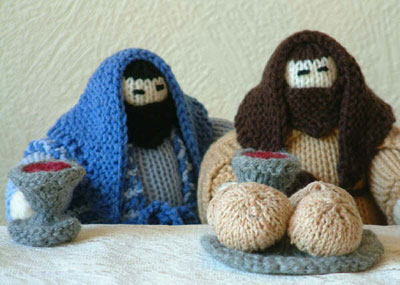
The Knitted Testament (from Ship of Fools)


Is it any surprise that The Blake Prize for Religious Art accepted an entry by journalists masquerading as artists? Sydney Morning Herald journalists Lenny Ann Low and Jenny Tabakoff created Our Last Supper and it was selected alongside 359 other entries for the tepid annual prize exhibition held at the National Art School.

In a
Herald article published on 7 September 2006, Low details the experience of making work for the Blake, asking the almost ye-olde-worlde philosophical question: "what happens when you have an idea and realise that art is the only way out?" For starters, I'm sure non-artists have this problem all the time. The lady who works at the school canteen suddenly has an idea and she thinks, "Fuck me dead if I can't make some art out of it!" It seems to me Low and Tabakoff are really just demonstrating to the world at large that anyone can be an artist these days, despite Low claiming in a fairly reductive fashion that:

"What some people consider a masterpiece is merely an indistinct scribble or a pile of clay to others. Then there are those who appreciate art, but lack the confidence to give it a go. Art, most people think, is something only artists do: it requires innate talent and years of training. If you have neither, it's hard to believe you can create art worthy of the name."

I long for the day when people start looking at contemporary journalism and say, "My child could write that!" They don't get called "hacks" for nothing. But that's beside the point because if Low and Tabakoff think they're hot shit because they got into the Blake Prize, then they are seriously deluded. Low asks in her article: "Could we concoct a work of art that anyone would take seriously?" And the answer, Lenny, would be no. That's because no one in the artworld takes the Blake Prize seriously. Yes, Artswipe did a psychic survey and everyone in the artworld agrees.

If the Blake judges were really that serious when they selected something like Our Last Supper, which Low and Tabakoff constructed out of their collection of "quirky knitted dolls," then they don't realise that knitted shit in contemporary art post-Mike Kelley is a big fat cliché. When I typed "knitted last supper" in Google Images, the results show a better range of images than what Low and Tabakoff produced. The reason they're interesting is because they highlight how religious art is only good for one thing: kitsch.

Saturday, September 02, 2006

Docile Biennales


Resistance is futile. I have spent the last few weeks battling the art demons in my head that taunt, "Write something about the 2006 Biennale of Sydney, Zones of Contact?" I'd reply: "And just how does one stretch the phrase 'I was bored shitless' over several paragraphs when I could instead renew my World Movies subscription – setting the VCR during anthropological documentary hour."

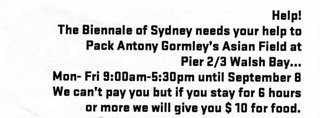
Eventually the demon forced some Artswipe commentary when I encountered a tiny cost-efficient flyer the other day at a Sydney artist run space. The small piece of paper was appealing for volunteers to dismantle Antony Gormley's massive installation, Asian Field, held at Pier 2/3 Walsh Bay. Comprised of approximately 180,000 life-like sculptures, the work is, to quote Gormley, "made by 500 assistants out of 125 tonnes of gritty brick clay in one balmy January week in Xianxian Village, Guangzhou in 2003." Photographs of the villagers who assisted appear in the gallery alongside their pick of the sculptures produced.

In her essay "Grasping the Thistle," which appeared in Zones of Contact: 2006 Biennale of Sydney: Critical Reader published by Artspace, Lisa Kelly succinctly noted how Sydney artists had an opportunity to be part of the event by volunteering for a Biennale where representation from artists in its host city was scarce. Kelly writes:

"Two days prior to the media preview of the exhibition venues, frantic calls for volunteers to assist – particularly with the installation of Antony Gormley’s work Asian Field – were put out to local artists. The pay off for this labour was touted as a chance to work with the artist and a ticket to the exclusive artists' party on opening night. Events this time around would suggest that the Biennale of Sydney holds the Sydney artist community first and foremost as a source of readily exploitable, behind-the-scenes labour."

Perhaps photos of the volunteers setting up the installation should have also been hung somewhere, to rightfully acknowledge Asian Field's multi-faceted dependence on mass-labour? When I viewed Asian Field, I set off an alarm that signified I was too close to the front line of clay creatures comprising the field. Immediately I was apologetic to the gallery assistant, but quickly realised he didn't care because I was part of another mass field of Biennale viewers who had set off that alarm. The sound of tourettic alarms screaming "back off motherfucker" tolled alarm bells of a more critical nature that forced me to read the work as a hermetically sealed environment of cultural otherness. I stood staring out on a world frozen in time and objectified by the time-honoured relationship of handmade artisan labour to an exotic cultural authenticity, however manufactured and trite. Anthony Bond notes in the Biennale catalogue that Asian Field is the first time in the 15 years since embarking on the Field installations that Gormley has pinned up photos of the individual producers. Anonymous mass labour no more – the Marxists in the Village would surely approve!

Having recovered from the embarrassing alarm setting-off experience and exercising my "Sunday best" in panoptic self-regulation, I took the obligatory snaps on my mobile phone camera as all the other viewers were doing. It was then I saw myself reflected in the clay docile bodies staring back at me. Mass responses to the work were mirroring the mass stillness of the field. If the Marxists in the Village can't be pleased, then the Foucauldian scholars among them would be furiously taking notes.

Asian Field certainly works on an aesthetic level, impressing with its monumental and somewhat inherent sense of golden wonder. You can't help but look upon this field as a landscape seen from space because the viewer is imbued with a spectatorial mastery not unlike the kind of experience you'd have if it was downloaded via Google Earth. As spectators we zone in and own the landscape; fields all over the world are brought into sharp focus, their exotic populations reduced to tiny specks of fetishised nothingness. When I saw the Asian Field one viewer said to the guard keeping gallery assistant "What does Communist China think about this work?" The reply was, "You'd have to ask them." Was Asian Field an exercise in commie critique perhaps?

Whatever it aims to do on the part of the artist, Asian Field is racist in the way it reduces Asianness to a generic signifier – much like the way "Asian" food is packaged in Western countries, when in fact you might be experiencing more specific styles of, for example, Chinese or Vietnamese cuisine. It's like Gormley sees all "Asians" as the same and undifferentiated, despite his attempt to showcase the Villager's portraits. Somehow the whole exercise smacks of a sweat shop mentality, and we all know that sweat shops have been particularly criticised for exploiting migrants from Asian countries.

So now citizens in the Sydney art community are being called upon to take down the Asian Field. What do you get in exchange? The flyer says: "We can't pay you but if you stay for 6 hours or more we will give you $10 for food." I couldn't help but wonder if it's $10 worth of food stamps, depression-era style. The thought of a poorly paid Biennale staff member standing there doling out $10 lots of petty cash to wide-eyed volunteers made for a rather surreal image. But no more surreal than the thought of actually wondering where you could dine on $10 in the Walsh Bay / Circular Quay area except perhaps McDonalds. It seems those behind art world institutions like the Biennale of Sydney probably believe in that cruel clichéd joke that artists next to migrants make up a majority of the staff who work at McDonalds. And really artists may as well line up to get jobs at McDonalds if they're expected to support the volunteerism attending large-scale events like the Biennale.

Sunday, August 27, 2006

Art Worth a Million Starbucks


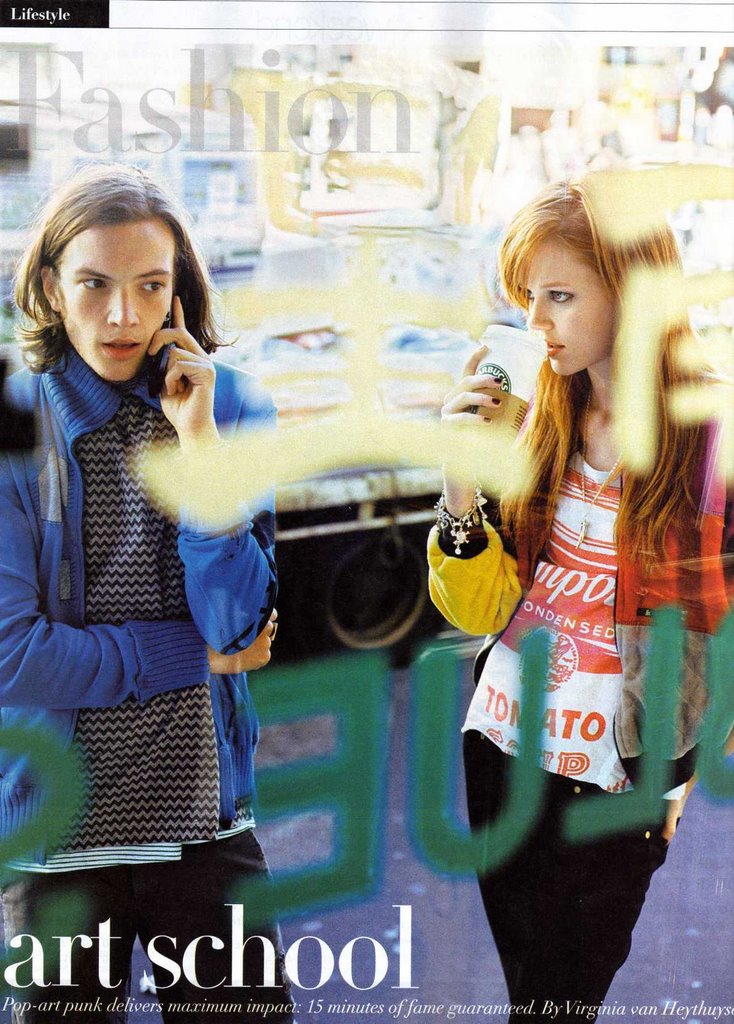
"Art School" fashion spread by Virginia van Heythuysen
Photo by Juli Balla (from Sunday Life, August 27, 2006)

Nostalgic for art school life, I've been wondering now for some time what the art kids of today are up to. What's hip for art hipsters today? This very question was answered today by The Sun-Herald, a newspaper that often answers life's big questions. When I'm not sure what to eat, for instance, I look at the celebrity photo pages because without a doubt an image of what's trendy in finger food is positioned between party snaps of Antonia Kidman and Peter Morrissey. All the big names in Australian culture no less! When I need to invest intellectual shares in current affairs, I turn to Miranda Devine for an enlightened stance on all things right wing.

Today's art hipsters rarely appear in the Sunday press, unless of course Urban Style columnist Fernando Frisoni has snapped them during a day of cruising East Sydney for young hotties garbed in recycled clothing, designer accessories and lusty trout pouts. My anxieties that art school chic is not media worthy on Sundays were quickly extinguished by the Lifestyle section of the Sunday Life magazine supplement of The Sun-Herald. Filling four pages are fashion snaps of a young white girl/boy couple getting around town suitably disengaged and absorbed more in consumer cravings than each other. Titled "Art School," the subheading claims, "Pop-art punk delivers maximum impact: 15 minutes of fame guaranteed."

In the first image, reproduced here at The Artswipe, the boy chats on his mobile phone, his hair carefully simulating that skanky unwashed look popular with skaters and crackwhores. The fine print lists the designer items worn and the grand total for a budding male artist's Art School image is $1322. Let's hope he's the next Matthew Barney so he can pay off those mounting student loans. As for the girl, Art School cachet costs $2054 and a Starbucks latté. Maybe she'll be Björk to his Barney, so the whole episode in elegant-slumming with a HECS debt will be worth it in the long run.

And what do you think these kids make at art school? Well their thing is critiquing consumer culture, because that never dates. They heard Johnny Boy's song, "You Were the Generation that Bought More Shoes and You Get What You Deserve," and were so inspired they made a painting appropriating the song's title before going shopping because it's, like, a political act, man. What struck me about this art duo is how invested they are in a seething electroclash of binary oppositions. Pop Art meets Punk (well, according to the subheading at least). And Campbell Soup always works when it's followed with a Starbucks chaser.

Friday, August 25, 2006

Jumping the Casting Couch


There's so much to cry about this week. With death everywhere I look, I'm at a loss knowing what to do with all these conflicting feelings. Grief is a funny emotion; it grabs you by the back of the throat, rams your brain in reverse, lunges at your heart, rupturing your tear ducts. At least, that is the measure of the emotional crisis I experienced yesterday when I heard that Tom Cruise was being sacked from Paramount Studios.

Yesterday afternoon I walked through Greek St, Glebe, past that big Church of Scientology, just hoping some young devout believer would stop me in my tracks, share the mysteries of the faith and more importantly lead me to where Tom might be hiding out. But no, it didn't happen. Apparently Tom Cruise hasn't been back to Australia since John Polson started making films in the US. (Potential-Screw-Loose-Cruise-Factoid No 1: Back in 2000, Tom sweated hard up-selling Polson's debut Siam Sunset to all the studio bosses in the US, when everyone else in the world acted more appropriately through indifference, or for those who actually saw it, sobs of abject vomit).

But, let's get back to the point. Grief is a funny emotion when it's mediated entirely through popular culture. Media and cultural studies academics everywhere got really self-congratulatory years back when Princess Diana's death afforded a lexicon of "globalised grief." Earlier this week when paying tribute to JonBenét, I was forced to negotiate the bittersweet signification of baby's breath: a wreath-like bouquet for the hair, baby's breath's symbolic innocence, virginity and bridal anticipation is no more suggested than in pictures of a beauty queen trapped in an image that doesn't breathe. But my grief for stars like Tom Cruise, and to a lesser extent Mel Gibson, is centred around postmodern fatigue and embedded in a lost image economy harking back to the Hollywood Studio System. I look at the mess poor Tom has made of things, and I wonder what Rock Hudson is thinking, looking down on Tom with a wink from that amyl-soaked Castro Street disco in the sky.

The Hollywood Studio system flourished between the 1920s to the early 50s, when the large motion picture studios of the day made movies with their carefully manufactured stars under long-term contract. I think Debbie Reynolds might just be the last actor alive from this era – it's a hunch, so don't quote me on that. But if the Hollywood Studio System, which really was a Star System, petered out some five decades ago, why does Tom Cruise's public shaming by Paramount actually feel a bit old-school Hollywood? Without a major studio, we just know that poor Tom may not survive. Action heroes divorced from the creatures comforts of a major studio are like fish out of water. So that’s why I went looking for Tom – or at least a kind believer willing to explain Tom to me – at Scientology Churches in Sydney yesterday.

I sat down on a couch with one very kind man of the Sciency brethren. (With due respect to Privacy Law, let's call him called "Max"). It was actually a couch not unlike the one Tom famously rode like a Brokeback rodeo on Oprah. Being so into terms, I decided to share with Max the impact Tom has had on the popular culture of our time. I told him how Tom's televised chair dancing antics spawned a term - "jumping the couch," which
UrbanDictionary.com defines as, "The defining moment when you know someone has finally lost his or her marbles. Inspired by Tom Cruise's behavior on Oprah when he jumped up and down maniacally on her couch, while professing his undying love for actress Katie Holmes. Reportedly much easier to accomplish than going off a 'deep end.'"

Max didn't care for my knowledge of pop culture minutiae, and certainly didn't seem to care for his celebrity elder. Max preferred I answer this whole swag of questions about mismatched numbers, words, ideas, sounds, and the like. That's far too fucking conceptual for even me. The only words of any true meaning that could come out my mouth at this stage were classic Cruise movie quotes. When I locked gaze with poor Max and said, "Respect the cock and tame the cunt," he called security.

Wednesday, August 23, 2006

White Goods for JonBenét


We are living in dark times, ladies and gentlemen. Or at least I feel like I'm having some kind of Sylvia Plath week – dead ladies and white goods. Recently I said to my neighbour, "Listen, Janet, I started a blog because blog culture lacks a genuinely honest voice in the dark cyber fog." Janet said, "You're like Lenny Bruce or Sandra Bernhard, riding a magic zeitgeist carpet ride into a networked world that needs new over-ripe diatribe." I felt humbled by Janet's endorsement and a little guilty because she obviously thinks I know something about "blog culture."

But yes, I do feel like it's time to cut through the bullshit and pay a little long overdue respect to the little lady of perky pageantry – JonBenét Ramsey. If I could say something to JonBenét and be assured she could hear me, I'd say:

"Since you've been gone, little lady, I've been in this really dark place because I know you would have grown up and been really important. Yes, you would have been getting all kinds of Nobel prizes for, say, inventing a more aesthetically viable substitute for the kinds of plastic purchased from Ikea or designing Braille for blind animals. I just know you would have done something cool and worthwhile like that."

But baby Benét never had a chance. Tarted up like a featured extra from Bugsy-meets-The Best Little Whorehouse in Texas, it's become clear there's a whole lot more going on since John Mark Karr has confessed to accidentally murdering her (yeah right, I'm really getting into accidents too – they're such convenient ways to describe strange phenomena). Anyway, I feel the whole Karr thing is a bit weird. It just doesn't ring true that this freak actually did what he claimed he did. I suspect he longs for some kind of demented notoriety because JonBenét has a starring role in his perverse fantasies. How could anyone who writes poetry for the littlies and claims they "identify with Michael Jackson" be guilty of crimes against a child? Surely Jackson was never found guilty of such a thing.

I reckon whatever love attachment Karr had for JonBenét was based on some confused fiction and reality distinction. In an era where the image reigns supreme, JonBenét has become one of our most beloved endorsements for Americana rendered iconic by the image. Like the US flag or an Andy Warhol soup can, JonBenét's little tiara-encrusted-hair-spray-do framed a sweet little face that spoke to dreams unrealised, hopes dashed way too soon. If I was a semiotics professor, I'd say she was signification gone awry – a poster child for the American fascination with sexing up kids and cashing in on precocious child-star talent ala Jodie Foster or Dakota Fanning. I'm waiting for the day Mattel releases an interactive board game for the US market called "Will the Child Star Crash & Burn or Win an Oscar One Day?" The tagline would be: "Roll the dice and you decide Little Man Tate's fate." (If you're playing as Haley Joel Osment, then you'll probably just get an Oscar nomination before heading into Star Rehab). If this game gets the corporate nod, I'll be sure to order one from Amazon because the Tall Poppy lopping Australian in me loves to see these little stars-and-stripes stay lopped.

Except when it comes to JonBenét the game gets a bit dicey because she reveals how kids in pageant land are manufactured as fodder for child porn fantasy. The whole child beauty industry is only good for one thing in my view: it provides hours of entertainment for connoisseurs of American trash culture. But really, it seems American culture doesn't see it that way, upholding its child pageant industry like it's a complex totem signifying innovation, progress, education, family values, patriotism, and good old fashioned shiny whiteness.

Whatever JonBenét represented then as much as now, I just can't shake the whole anxiety that whether or not this Karr person is really guilty, he's symptomatic of a culture happy to consume kids painted in grown-ups drag as if to satiate a line blurred between childhood innocence and adult fantasy.

Monday, August 21, 2006

The Death of the Artist

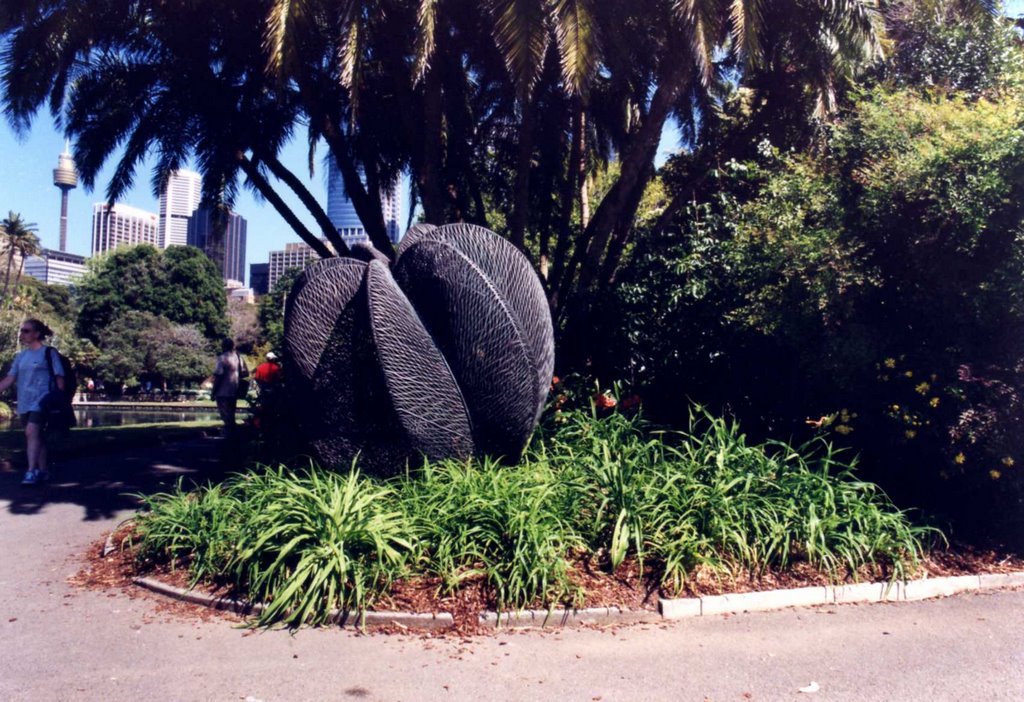
A Bronwyn Oliver sculpture (Photo: The Artswipe)

Though I never met her, the death of Bronwyn Oliver - who on July 11, 2006, took her own life - came as a shock, and filled me with a deep sadness. Images of the Australian sculptor's work started appearing everywhere, and while I have been very familiar with her practice over the years, I started to scrutinise the work on a much deeper level. And I started to feel really, really sad, and filled with a loss that baffled me considering I had not given her work much thought in the past.

Writing in the Sydney Morning Herald - Spectrum (August 19, 2006) John McDonald rightfully claimed: "There is a terrible delicacy in writing about an artist who has recently taken her own life... Whatever one writes about the artist at this time will inevitably stand in the shadow of her death." I couldn't agree more. The intractable scrutiny I experienced in recent weeks while pondering Oliver's oeuvre, is that I find it difficult to shake off the impulse to find evidence, some clue pointing to the mysteries of why she took her own life. But all I find is that terrible, uncanny beauty that she so gracefully extracted from the soft folds of nature and transformed into hard-wired sculpture. It's a line of beauty that has overtaken me somewhat, forcing me to revisit all those artist-as-troubled-genius mythologies we're taught at art school to avoid.

I wandered into Roslyn Oxley9 Gallery on Saturday afternoon to check out Oliver's final solo exhibition and was delighted that the gallery was packed with so many people -- I actually can't remember the last time I visited a gallery with such healthy number of visitors at a time that did not coincide with the free booze of an opening night. I had been putting off visiting Oliver's show, even though it was my intention to pay my respects before the exhibition closed. But a part of me was a bit resistant to attending the exhibition because it would test whether my response to the work would be ideologically knee-jerking my critical faculties into blurring the line between an artist's life and their work. Could I put to the test whether Roland Barthes' "death of the author" argument actually worked when it came to the crunch? Much of the recent press about Oliver has focused on how intensely private, obsessive, hard-working and exact she was. Basically it seems Oliver was a big enigma in the artworld to those who knew the work but didn't know the person, because for starters she was rarely seen schmoozing at flashy Biennale openings and the like. (And I'm guessing most artists see more of each other at openings than they do their art. Unless of course checking out the stills of an artist's current exhibition on their dealer's website has become the equivalent of physically attending an exhibition).

Back to my point. It's precisely because Oliver was such a mystery that her work has been charged with a magnetic force that invites almost morbid speculation: Why did she do it? What could have been so terrible for her to do what she did? Such questions can never be sufficiently answered, so I reckon we should stop asking. But even if we do, it won't stop us from reading her work in ways that cannot but be divorced from knowledge of the death of this particular author. And in a sense that really depresses me. Because I wanted to think I could be more critical than that. I'm not saying Oliver's work doesn't deserve the praise. If anything, her work deserves so much more than our passing tributes punctuated with odd bits of nausea-inducing gossip about the circumstances surrounding her death. It is undeniable that Oliver was a brilliant artist and let's hope she will be admired for generations to come. Such a thought is somewhat optimistic because it means future generations viewing her work may elicit a necessary detachment from the work to set aside for a moment the "shadow of her death" and focus on the aesthetic, conceptual and technical wonders contained therein.

After attending the Roslyn Oxley9 exhibition, it dawned on me that I took a photo of one of Oliver's sculptures years ago -- I think it was 1999 or 2000 -- while doing a Sculpture Walk across Sydney. And while I remember at the time being pretty amazed by Oliver's achievement, the feeling of wonder passed rather quickly because ultimately like most of us I suspect, it wasn't attached to some romantic narrative of the artist's troubled life and death.

Friday, August 18, 2006

God Grant Me the Semitic


John Waters, Straight, 1996
John Waters is represented by
Arthur Roger Gallery in New Orleans, Greg Kucera Gallery in Seattle, and probably others.

So let's turn to "recent world events." Mel Gibson has been ordered to say his "God grant me the serenitys" at Alcoholics Anonymous meetings five times a week for four and a half months and three AA meetings per week for another seven and a half months. He's also been ordered to enrol in an alcohol-abuse program for three months, fined a paltry sum of $US1,300 ($AU1,694) and had his licence restricted for 90 days.

I'm a bit pissed off by all of this actually. Mel Gibson shouldn't be punished for drinking - this actually makes him bearable. Rather, he should be punished for his crimes towards cinema. Just imagine how much of better place this world would be if we'd never had to witness Maverick, What Women Want and The Man Who Got Off His Face? Of course, if bad cinema doesn't make him punishable, then the whole anti-Semite thing should put him up there on the "naughty shelf" with all the war criminals. Writing in the
Sydney Morning Herald (August 11, 2006) playwright Louis Nowra claimed that the media's attacks on Gibson were "sanctimonious," "blown out of all proportion" and "shows a disturbing trend in this era of media witch-hunts." I disagree, Mr Nowra. It's a sink or swim situation out there in celebrityland and a good-old-fashioned witch-hunt rekindles our literal joy in hanging the witch if they don't drown first in their own vodka vomit.

Maybe I'm being just as hateful as Mel. Actually no one could be. The notorious film director John Waters (Pink Flamingos, Polyester, Hairspray) once exhibited a photo (yes, he takes photos of TV screens) about Mel's apparent hatred of gays. Is there anyone Mel don't like?

As Waters writes in his book of art photos, Director's Cut (Scalo, 1997): "Of course I can be hateful if I'm pushed... [On] Mel Gibson: Don't get me started on his homophobia. One shot of his name, matted crookedly and entitled Straight (1996) says it all as far as I'm concerned."

Friday, August 11, 2006

Group Mentality


The Kingpins
Sydney Infinity, 2005
Courtesy the artists and Kaliman Gallery

Solo shows have become group affairs! Artistic collaboration is no new thing, but why is it such a hot thing in the Australian art scene right now to accelerate your profile by forming an artist duo or group? It seems you get instant attention if you actually bear more resemblance to some kind of parallel universe Australian Idol act bearing a really ironic name and doing the circus clown routine absolutely everywhere including the gallery space. The Kingpins, soda_jerk, Ms & Mr, Gossip Pop, the Motel Sisters, Wild Boys, and probably others I've forgotten about, all comprise the phenomenal proliferation of artist groups in the contemporary Australian art scene. And while she is a solo act, Danielle Freakley's project Artist Running Space (where she pretends to be a human gallery by exhibiting other artists' work on her white-cube-for-a-head) may as well be a group act because there's always her performance adorned by someone else's images. Actually that's given me an idea: maybe artist Simon Barney should become his mobile Briefcase space, and to view the art he would open up like that McDonalds advert where children hatch out of their parents Babooshka Doll style in search of the perfect Meal Deal.

I'll admit, these bright young group things make great work for the most part and shake up the often staid state of the arts. But my cynical side often wonders if art today needs this kind of glossy hook in order to make an impact, or at the very least, get some crowd-pleasing attention. I'm all for the dismantling of the high/low binary which once claimed art as elite and pop culture as its inbred cousin. Art today is another form of pop culture, even if it is unremarkable for a mostly disinterested mass audience. Certainly, the engineering of the art star is testament to such celebrity-invested phenomena that sees art as 'the new entertainment.' What bothers me is that while this trend of the artist group has produced some interesting and/or entertaining artwork I fear that critical art culture has suffered a bit of a dumbing down. Just because a catalogue essay might herald the work in Baudrillardian or McLuhanesque terms doesn't mean the work's gonna be that hot next year. And while postmodern culture is specifically manufactured around its very impermanence, I don't really think the current crop of performative art groups popping up have thought too hard about when, where or how their deaths will be staged. Rather, their deaths may happen the hard way: through failed comebacks, where their work may one day forlornly line the bargain bins of the commercial galleries that once clamoured to represent them.

→ ↑ → perform at George Patton Gallery, Melbourne, 1980.
Photo by Judy Annear and sourced from Darren Tofts'
Fibreculture essay

For all the fun to be had by this new wave of art/pop or pop/art stars, we must never forget that → ↑ → (pronounced 'tsk tsk tsk') was probably the best art pop group to have emerged in Australia. → ↑ → paved the way for the kinds of experimental, performative and ‘hybrid’ multimedia works featured ad nauseum in galleries and museums today. Thankfully the Kingpins know to honour their 'artcestors.' In the recent issue of Photofile (77, Autumn 2006) the Kingpins interview Philip Brophy, the Melbourne artist who formed → ↑ → in the late 1970s and who has since carved out an impressive body of work as a solo artist making film, video, sound, design and scholarly commentary. The article is illustrated with a glossy production still where Brophy and the Kingpins pose pirate-style in a pop combo called 30 BMP. Inspired inter-generational post-pop art perhaps?

Whatever it is, we shouldn't forget that Brophy, in an earlier issue of Photofile (74 Winter 2005) claimed: "An artist using a pop song in video art is like anyone either enrolling in a DJ course or wearing an iPod in public: TRAGIC."

Funny that, because without pop songs some of the Kingpins' videos just wouldn't work. And as for Brophy's Evaporated Music – well it is entirely based on deconstructing the sonic elements of a few TRAGIC pop music videos! If we took the pop songs out of a lot of recent art all that would remain is some weird kind of out-take or blooper reel found in the Special Features section of a DVD that doesn't exist but is called Untitled (Very Cindy Sherman).

Friday, August 04, 2006

Lady Flattery

Tracey Moffatt
(photo by Steven Siewert from The Sydney Morning Herald)

Recently The Sydney Morning Herald reported that Tracey Moffatt, the glorious doyenne of art glamour, is making a new series of portraits of artworld figures and celebrities that will flatter all involved, "making them appear 20 years younger." If anyone can pull this off, it's Ms Moffatt because she understands better than anyone that a polished aesthetic is the secret to eternal youth. And for Moffatt, Photoshop covers over a multitude of skins – I mean sins – associated with aging. I wondered if maybe she wouldn't mind taking a portrait of Kathleen Turner, because the poor thing didn't take too kindly to age. In the eighties, when Turner ruled Hollywood, the age-youth-beauty nexus was basically branded by Turner's face. Now darling KT is all alone in a young, beautiful world ruled by whoreskanks like Lindsay Lohan. Actually, maybe Ms Moffatt could take a portrait of Lohan because 20 years younger and she'd appear all fetal, and that's my favourite look this season.

Tuesday, July 11, 2006

iSpace


In recent weeks I have been really fascinated by the phenomenon of MySpace. So many of my (actual) friends have contacted me to encourage me to create a MySpace page: "You don't exist without MySpace," they say, "We can be friends online." (And here I am, thinking it's sometimes hard enough maintaining friends in the real world!)

So what is it about MySpace that has everyone moving in? I don't make it a habit to answer my own questions, as Philosophy was one of my hobbies back in the day. (Philosophy taught me that 'negotiation,' 'engagement' and 'dialogue' are words to be used in any sentence where an answer might be required). I think web-nerds (bloggers included!) are moving into MySpace because most net and new media speak specialises in a myth of self-recognition. We believe the hype of a new computer-mediated phenomenon if it is invested with a sense of (pseudo) individuality. Apple has a corner on this market, having named their product range after the 'i' of identity. The customisation of the iPod, iTunes, iPhoto or any other Apple product is stressed by the 'i' – a reference to lowercase selfsameness.

Even iPod ads cash in on the oldest advertising trick: presenting silhouetted figures blanked out and lacking identity to facilitate the psychic projection of ourselves onto these human colour fields. And the iPod and its wife iTunes present the illusion that we're in charge of the digital music revolution. By creating customised Playlists, the consumer is championed as a unique author, the artist a secondary effect. If iPod ads are to be believed, mp3s of our favourite songs provide a mere soundtrack to our identity and singularity. But not a days go by when I don't see the world overrun by iPod people, including myself. Where's the individuality here?

While the Artswipe got serious on some veiled Marxist critique of the iPod and its friends, an automated email from iTunes announced that it's New Music Tuesday. Following I bet, another MySpace Monday.

Sunday, July 09, 2006

Women Who Rape Men and Other Revelations

The Book of Revelation (Directed by Ana Kokkionos, 2006)

Recently I saw a new Australian film called The Book of Revelation. Directed by Ana Kokkinos and based on Rupert Thomson's novel, The Book of Revelation centres on Daniel (Tom Long), a dancer who leaves dance rehearsals one afternoon to buy (on command) a pack of cigarettes for his boring dance partner girlfriend (Anna Torv). When he doesn't return, the dance company gets worried, but replaces him nonetheless. The show must go on. Little did they realise poor Daniel had been abducted by three women cloaked in what appeared a kind of Opus Dei drag. They chain him to the nicely polished floorboards of a seemingly abandoned building for about ten days and demand sex on command. Every straight guy's fantasy come true.

Probably not. Wanking on command with three cloaked freaks staring at you is not actually a trademarked straight male fetish the last time I checked. Neither is being fucked by a chick with a strap-on while chained to the floor (again, nicely polished – they knew he was a dancer). OK, I get it. It’s a feminist film. And I am way into feminism, but really, this little morality tale gets overwhelmed by its own sense of purpose. The basic premise is this: women can rape men and get away with it because no self-respecting straight guy is ever going to report it. (In one scene Daniel tries to report the incident to two macho cops but pretends out of embarrassment that it was a male friend who was abducted by three women. They laugh and call his "friend" a lucky bugger). The Book of Revelation is not heavy-handed simply because of the rape scenes: these moments actually sustained what was otherwise a rather tepid and overlong thesis about (as you’d imagine a nervous Press Kit would put it) "thematics of sex and power."

And thematics is what dancers do best, especially when Meryl Tankard is your choreographer. When released back into the world by his hooded captors Daniel goes on a nicely choreographed sex binge. Motivated by finding his rapists and some retribution (in line perhaps with the title's Biblical allusions), Daniel's task is difficult because he only has a few distinguishing markers to go on: grey robes, nice perky tits, shaved pussy, red fingernails and some mysterious looking tattoos - the kind of sexually coded tattoos popular I'm sure in cleavage and hip areas at present. He fucks every sexy woman in Melbourne (straight male fantasy pay-off?), in search of these elusive markers. Counting his conquests on the wall, Daniel is a like a prisoner wishing away the days until probation. These scenes were great because they suggested the experience of being raped for men has a Janet Frame quality (as seen in Jane Campion's An Angel at My Table when poor genius Janet writes all those crazy things on the wall of the "loony bin"). Another great thing about The Book of Revelation is seeing the entire female cast of The Secret Life of Us being utilised (Anna Torv, Deborah Mailman, Sibylla Budd, Nina Liu). And then there’s the long overdue comeback of Nadine Garner – my personal favourite Aussie TV star of the twentieth century appearing briefly. Can someone please give her another starring role? Preferably with Justine Clarke as her sidekick.

Look, edgy independent films usually turn me on, and sometimes the really pretentious ones make it into my DVD collection. But as much as I wanted to like The Book of Revelation, I must admit I was frankly pissed off because I had expected better from Kokkinos. No stranger to controversy, her first feature Head On (1998) was one of the best Australian films of the nineties. Based on Christos Tsiolkas'
novel Loaded, Head On was a tour de force joyride through seamy gay Melbourne where Greek boy Ari (Alex Dimitriades) can’t seem to reconcile cock and Greek culture (strange, but true). Perhaps I expected The Book of Revelation to be on par. Well, it's compelling, sure, because not many other Australian films dare go there. And Kokkinos knows this because she basically thought she was making a French film. It's like she rented Catherine Breillat's back catalogue at Blockbuster and decided:

"Yeah, women can be cunts and feminists, and I want to explore that. You know, straight men have had it really, really hard – especially straightboy dancers. Look, they go through life being accused of being sissyqueers when their sensitivity is so much more complex than some gay conflation. Maybe if a straight boy dancer gets raped by three masked women, the story will really fuck with convention."