Showing posts with label Roslyn Oxley9 Gallery. Show all posts

Sunday, April 27, 2008

Stomach Liner

The Artswipe
Fluff, 2008
Endurance performance
Courtesy Coles

The Artswipe discovered a new nutritious product this week. It's called Fluff and it is available at your local Coles for approx $3.29. I've used it to line my stomach before drinking cask wine served at Firstdraft last Wednesday night. For those of you who haven't seen the Firstdraft show, don't worry about it, you'll get over it, we always do in the end.

Fluff came in handy that night (I didn't spew once!) and it's bound to come in handy this week as another circuit party of art openings are almost upon us (Roslyn Oxley9, James Dorahy, MOP, Chalkhorse and probably more). The Artswipe plans on being present at all of them, with Fluff in hand.

The one that has really piqued my interest is
Oblivion Pavilion, a group show at Roslyn Oxley9 Gallery featuring several emerging type artists, most of whom make art with a "naive" sensibility - something particularly in vogue at present. Oblivion Pavilion includes Marley Dawson, Agatha Gothe-Snape, Matthew Hopkins, Emily Hunt, Tim Schultz, Raquel Welch and is curated by Amanda Rowell. In case you've misplaced your dream dictionary (I left mine on a bus last week) don't fret, the exhibition statement for Oblivion Pavilion makes a handy proxy:

Gonadal inclination is on the decline in the original amusement zone. The slumbering brainchild is concussed and abandons all pre-programmed language to riddles. We are left to process life’s rich pageant with dumbed-down neuronal and emotional apparatus and tinker with schizophrenic tools in order to assemble meaning. Memorials -- flashbacks in the story department -- are witnesses to system’s upheaval. Imagination compensates across the memory gap.

Amidst the ruin, the thought factory, a mechanical and apparently risk-laden contraption processes incessantly. It conveys discrepancies between work and play, a nuts-and-bolts-type scenario constructed via the difference between effort and effortlessness, alternating between building an empire against and giving in to sometimes agreeable, sometimes disagreeable forces.

The subject is adrift in a world not firmly located. Substance and the limits and comparative scales of things are fully negotiable. Fluids emanate from the medium. Eggs, classical architecture etc. are equally fragile forms. The structure of the eye is part of the structure of the brain. In a fit of decoration, architecture gives birth to furniture.

Language is architecture. The variable product of the combinative function. Mottos are props, signposts by which to navigate personal inclinations and flag sympathies within the heart of things. A face – an edifice – answers a question. It adorns the gates of exalted memories. It rearranges things to find new meaning. Living has been only due to the kindness of others.

Monday, August 21, 2006

The Death of the Artist

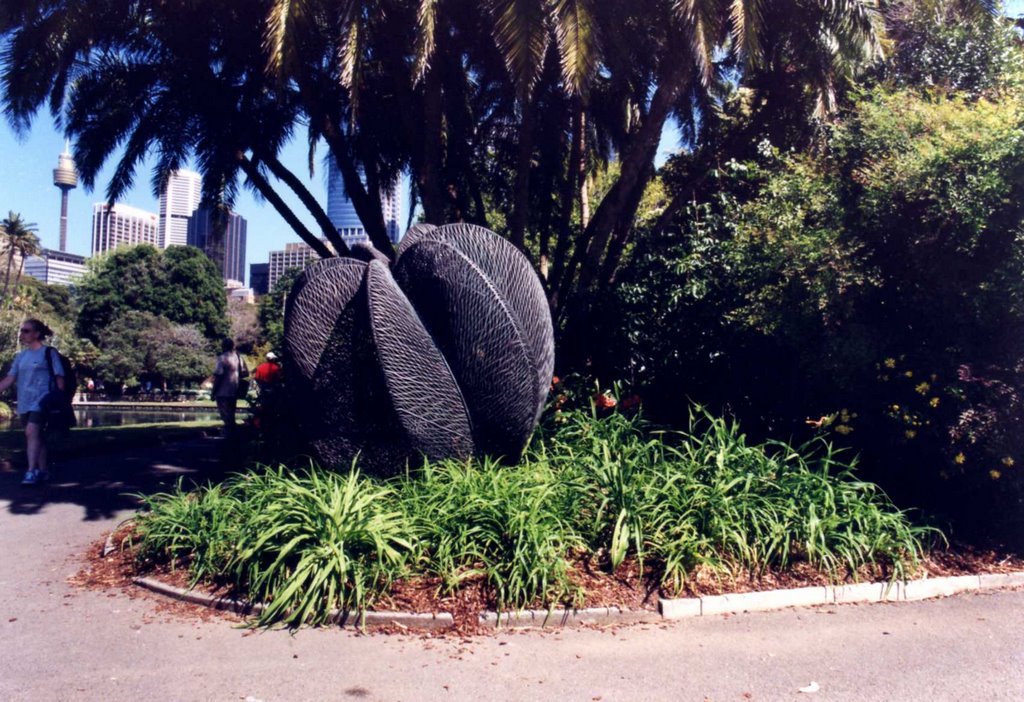
A Bronwyn Oliver sculpture (Photo: The Artswipe)

Though I never met her, the death of Bronwyn Oliver - who on July 11, 2006, took her own life - came as a shock, and filled me with a deep sadness. Images of the Australian sculptor's work started appearing everywhere, and while I have been very familiar with her practice over the years, I started to scrutinise the work on a much deeper level. And I started to feel really, really sad, and filled with a loss that baffled me considering I had not given her work much thought in the past.

Writing in the Sydney Morning Herald - Spectrum (August 19, 2006) John McDonald rightfully claimed: "There is a terrible delicacy in writing about an artist who has recently taken her own life... Whatever one writes about the artist at this time will inevitably stand in the shadow of her death." I couldn't agree more. The intractable scrutiny I experienced in recent weeks while pondering Oliver's oeuvre, is that I find it difficult to shake off the impulse to find evidence, some clue pointing to the mysteries of why she took her own life. But all I find is that terrible, uncanny beauty that she so gracefully extracted from the soft folds of nature and transformed into hard-wired sculpture. It's a line of beauty that has overtaken me somewhat, forcing me to revisit all those artist-as-troubled-genius mythologies we're taught at art school to avoid.

I wandered into Roslyn Oxley9 Gallery on Saturday afternoon to check out Oliver's final solo exhibition and was delighted that the gallery was packed with so many people -- I actually can't remember the last time I visited a gallery with such healthy number of visitors at a time that did not coincide with the free booze of an opening night. I had been putting off visiting Oliver's show, even though it was my intention to pay my respects before the exhibition closed. But a part of me was a bit resistant to attending the exhibition because it would test whether my response to the work would be ideologically knee-jerking my critical faculties into blurring the line between an artist's life and their work. Could I put to the test whether Roland Barthes' "death of the author" argument actually worked when it came to the crunch? Much of the recent press about Oliver has focused on how intensely private, obsessive, hard-working and exact she was. Basically it seems Oliver was a big enigma in the artworld to those who knew the work but didn't know the person, because for starters she was rarely seen schmoozing at flashy Biennale openings and the like. (And I'm guessing most artists see more of each other at openings than they do their art. Unless of course checking out the stills of an artist's current exhibition on their dealer's website has become the equivalent of physically attending an exhibition).

Back to my point. It's precisely because Oliver was such a mystery that her work has been charged with a magnetic force that invites almost morbid speculation: Why did she do it? What could have been so terrible for her to do what she did? Such questions can never be sufficiently answered, so I reckon we should stop asking. But even if we do, it won't stop us from reading her work in ways that cannot but be divorced from knowledge of the death of this particular author. And in a sense that really depresses me. Because I wanted to think I could be more critical than that. I'm not saying Oliver's work doesn't deserve the praise. If anything, her work deserves so much more than our passing tributes punctuated with odd bits of nausea-inducing gossip about the circumstances surrounding her death. It is undeniable that Oliver was a brilliant artist and let's hope she will be admired for generations to come. Such a thought is somewhat optimistic because it means future generations viewing her work may elicit a necessary detachment from the work to set aside for a moment the "shadow of her death" and focus on the aesthetic, conceptual and technical wonders contained therein.

After attending the Roslyn Oxley9 exhibition, it dawned on me that I took a photo of one of Oliver's sculptures years ago -- I think it was 1999 or 2000 -- while doing a Sculpture Walk across Sydney. And while I remember at the time being pretty amazed by Oliver's achievement, the feeling of wonder passed rather quickly because ultimately like most of us I suspect, it wasn't attached to some romantic narrative of the artist's troubled life and death.