In today's Sun-Herald – Artswipe's favourite weekend Bible – Bono defends Madonna's decision to adopt David Banda: "I'm very happy that Madonna should offer succour and more than that to a young boy," Bono said. "He's got a great opportunity now." The article goes on to reveal that Bono was once offered an African child by a desperate father, but was unable to take him home. Apparently the boy's face "haunts him to this day" and is the reason Bono started campaigning for African poverty relief. Surely Bono could have taken the boy on as staff? He does employ a whole fleet of people to attend to his family's every need.
Earlier this year Bono and Bobby Shriver, Chairman of Data, created a product line called (RED), which aimed to raise awareness and money for a global fund to help women and children with HIV/AIDS in Africa. (BLOG) RED documents the journey, which in recent months has seen Gap, Apple, Motorola, Converse, Emporio Armani and American Express release products associated with the (RED) brand. If you buy (RED) you are helping the fight against HIV/AIDS.
Why "red"? Well, in my last post, I suggested – quite crudely I admit – that red and black work quite well together. Red string works on black skin. Even Coca-Cola know they're onto a good thing with their black and red visual identity. The tension the (RED) campaign raises is the way it purports to be about politics, when really it's about aesthetics. Writing about fascism in the epilogue of the famous essay "The Work of Art in the Age of Mechanical Reproduction," Walter Benjamin argues: "All efforts to render politics aesthetic culminate in one thing: war." Bono is certainly not alone today in his attempts to "render politics aesthetic." Much art and popular culture thrives on this instinct, and certainly, Artswipe believes that aesthetics sparkle brighter than ever when charged by the frisson of political engagement – but only when the machinery of propaganda isn't facilitating such processes.
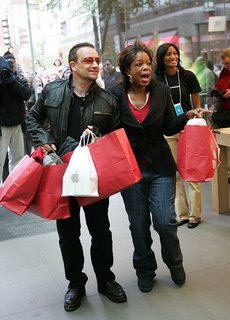
Buy (RED) and we can feel like we're fighting dire social problems like the spread of HIV/AIDS in poverty stricken corners of the globe. Our rampant desire to shop can now feel justified as charity. We're saving the world when we buy a Motorola phone. Can the receipt for a purchase of a (RED) iPod Nano be claimed as a charitable tax deduction? When we spend big on (RED) American Express and get into monstrous debt, does the exorbitant interest charges also go to help Africans with HIV/AIDS? Even Oprah – Artswipe's favourite philosopher (after Walter Benjamin) – champions (RED), taking the time and photo-op to spend big with Bono. Of course she supports it! Oprah obviously has a major shopping addiction. If "EVERYBODY GETS A CAR!" (as her entire studio audience did in one infamous 2004 episode of her talk show) it's only because she feels compelled to momentarily alleviate her own conspicuous consumption.
Charity begins at home and homes always look better when decked out in a wealth of commodities. Consumed with fervour in the western world such commodities become tokens of cultural, social and even intellectual capital, even if their origins derive from non-western sweat shop labour. (RED) labours under the weight of such good intentions to conflate the frenzy of consumer culture with social responsibility.
Why is it branded "red"? Simply because the issue is not as political as it is aesthetic. As aesthetic as blackness is for a white western culture bred on a Benetton "united colours" mentality. Perhaps signifying blood, which with or without the stigma of HIV/AIDS is still coloured red, the (RED) brand reveals its shallow aestheticisation of race as if it's a Dulux colour chart in its revealing manufacturing of blackness.
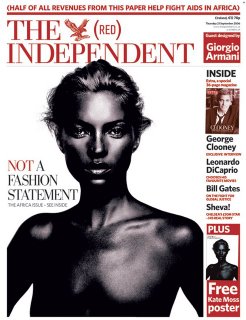
For celebrities endorsing the (RED) campaign, blackness is a commodity that can be purchased symbolically. Through cash register empathy, blackness can be bought to ensure the privilege of whiteness is momentarily used for good. Kate Moss appeared on the cover of the UK magazine The Independent in blackface with the headline, "Not a Fashion Statement." Touted as "The Africa Issue," this September 2006 edition of The Independent was designed as an eye catching tie-in with Bono's (RED) campaign. In her opinion piece for the Sydney Morning Herald, Emily Maguire writes:
"The stereotypes in these campaigns range from the banal (African equals beads and face paint) to the offensive (Africa equals AIDS). Both contribute to the biggest Western misconception of all: that Africa is a monocultural mess waiting for Westerners to come and clean it up. Africa is a continent, not an issue. AIDS is a disease, not a cause. And while celebrities may believe they are helping by raising awareness, they are, in fact, telling us what we know and creating a false sense that the problem is being addressed."
Maybe The Independent is right: maybe this whole campaign is a worthy cause and "not a fashion statement." Perhaps Madonna had simply purchased everything in the (RED) catalogue to match her red Kaballah accessories, and after a Sunday afternoon bout of consumer fatigue, simply decided babies over brands.
Whatever the case, white bread has never been so (RED).